Round-Trip Invariant
A property test asserting that minting shares and immediately redeeming them can never return more assets than were put in.
The round-trip invariant is a property used in invariant testing of tokenized vaults: for any user, depositing assets to mint N shares and then immediately redeeming those N shares must never return more than was deposited. Formally, a mint-then-redeem cycle should burn at least as much value as it created — the vault must never be a source of free assets.
Why it matters
A round-trip that returns more than it consumed signals that the vault's rounding or share math favors the depositor somewhere it should favor the vault, which is the fingerprint of value leakage. a16z's erc4626-tests suite applies this check and has caught real mainnet vaults returning a few extra satoshi per round trip — small individually, but exploitable at scale or via flash loans.
Relationship to the inflation attack
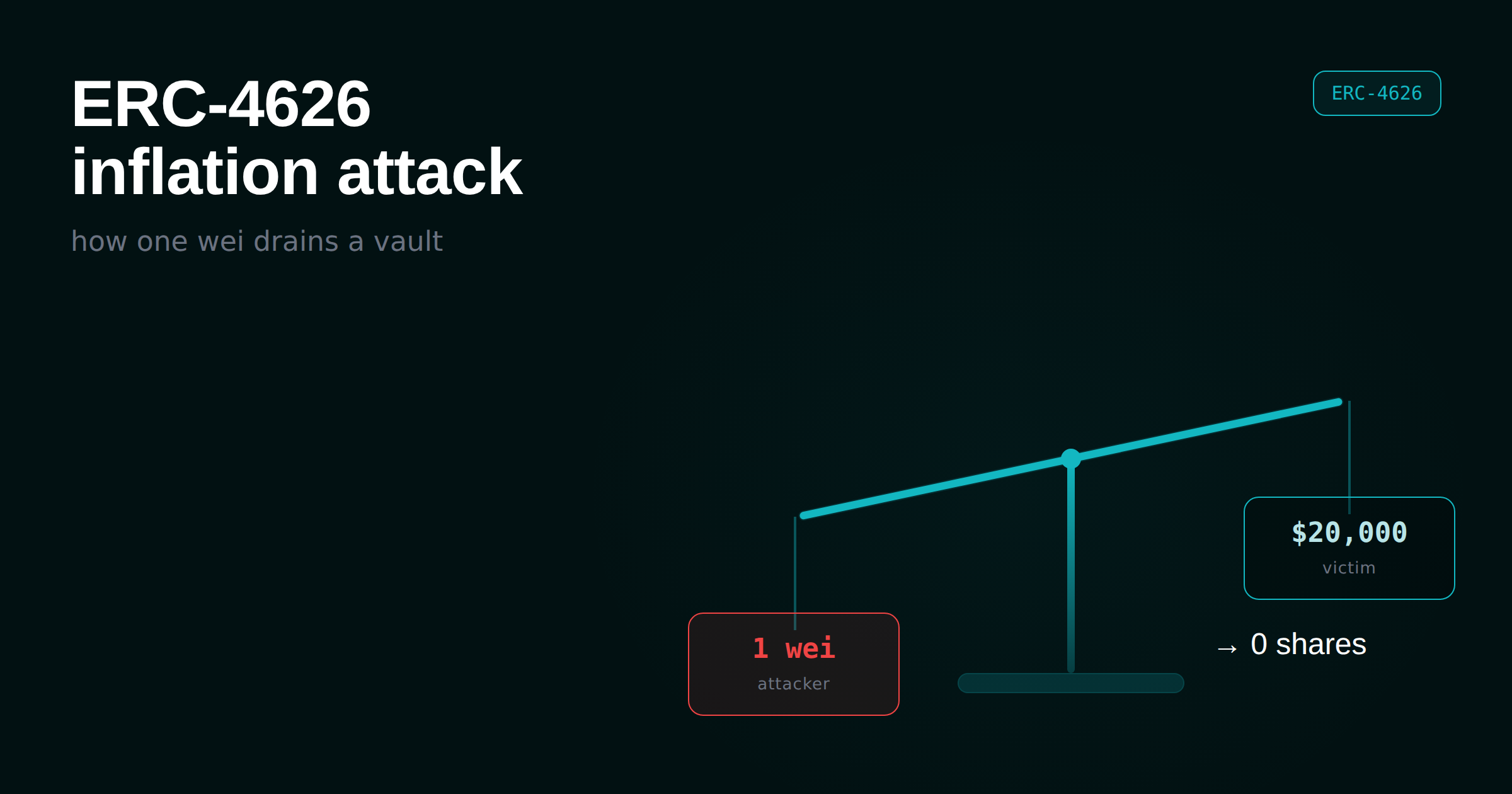
The round-trip invariant is one of a short family of ERC-4626 properties (alongside "no zero-share deposits" and "price per share is transfer-invariant") that together catch the inflation attack. Because the property must hold across any call sequence a fuzzer generates — not just a hand-written path — it surfaces the hostile deposit → donate → deposit interleaving that unit tests almost never visit, provided the harness starts from an empty vault and can perform raw donations.
Articles Using This Term
Learn more about Round-Trip Invariant in these articles:
Related Terms
Invariant Testing
Property-based testing approach verifying that critical protocol conditions remain true across all possible execution paths.
ERC-4626
Tokenized vault standard providing a unified API for yield-bearing vaults with deposit, withdrawal, and accounting functions.
Fuzzing
Automated testing technique using randomly generated inputs to discover edge cases and vulnerabilities in smart contracts.
Inflation Attack
Vault vulnerability where attackers manipulate share prices by directly donating assets, causing victims to receive fewer shares.
Need expert guidance on Round-Trip Invariant?
Our team at Zealynx has deep expertise in blockchain security and DeFi protocols. Whether you need an audit or consultation, we're here to help.
Get a Quote