Back to Blog 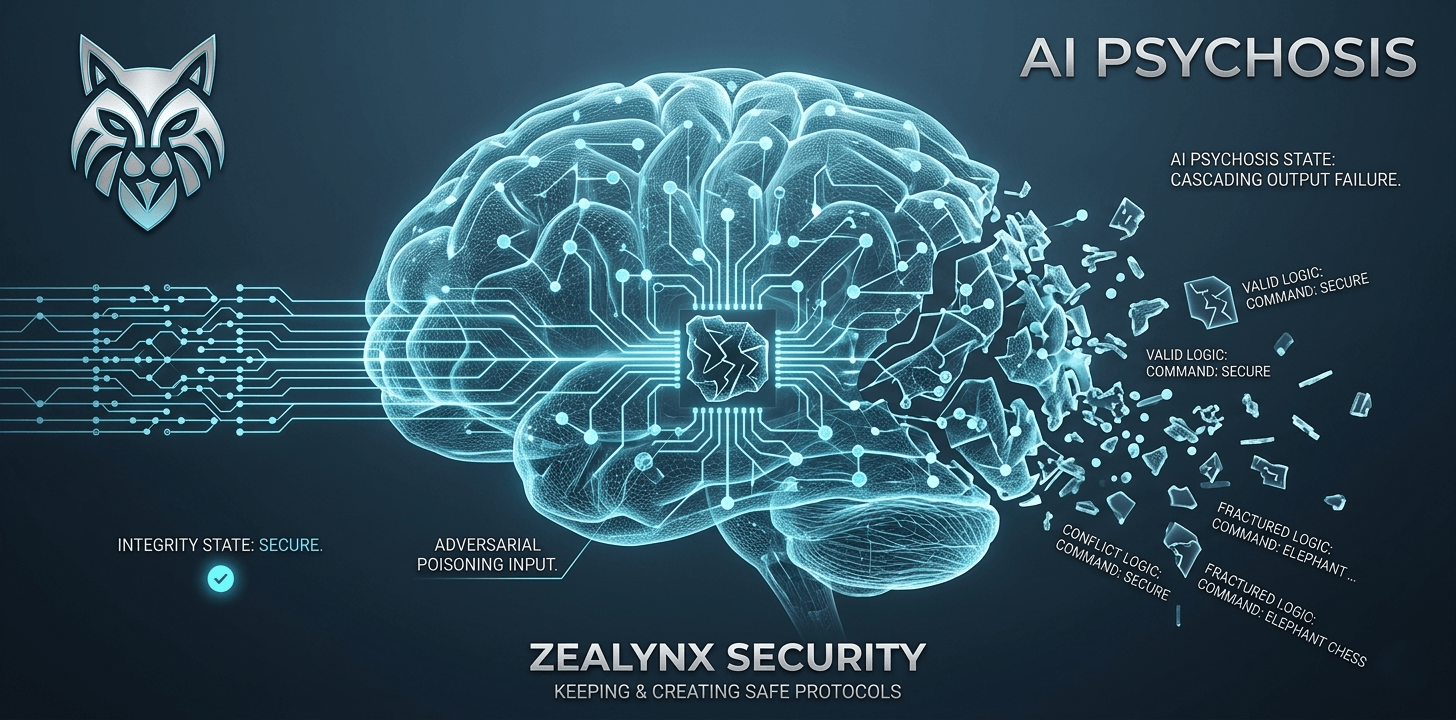

Introduction
AI is becoming a major part of people's lives. Most powerful AI models are trained with large chunks of data which determines the major characteristic outcome of the models.
Based on the psychiatric mental research sample at Jama Network, there are recent reports of the use of AI chatbots for mental health advice by teenagers and adolescents between the ages of 12 and 21.
While this concern seems to be very scientific and health-focused, there is also a responsible shift in how models should be debugged from a security perspective, especially for Generative AI Models.
With the current relationships users are building with AI, there is bound to be a parasitic relationship when the relationship becomes harmful to the host (user). This isn't an immediate process, rather a long-term and gradual process as it is caused by reinforcement of users' false beliefs.
While the introduction above is really based on psychology and health, this is an indication that hallucination hazard in AI can affect many industries and not just smart contract security or application security and coding agents.
In general, there is a performance limitation or degradation with prolonged use of an AI model. This is a major reason AI giant companies tend to discontinue some model versions after a period of time.
The Corruption Virus
Recently in the early quarter of 2026, lots of developers have complained about degradation in performance of some coding agents such as Claude Opus 4.6.
Now the big question is, what is the major problem?
Why is it happening?
Is this Hallucination?
Before we really debug this issue, let's address it from the viewpoint of human psychology as the foundation for modern-day AI. We will start by explaining psychosis.
I understand, this term really feels strange as a non-medical engineering term.
Psychosis is simply a medical term used to describe a mental health condition where a person seems to struggle to distinguish between imagination and reality. This results in hallucination and delusions.
Now, psychosis is majorly caused by environmental stress, a mix of genetic brain chemistry, and imbalances. This pattern can also be used to debug the AI problem.
Now that we know the basics of psychosis, the big question is, how does this relate to an AI model degradation problem.
Insight: Based on the recent complaints from users of Claude Code, around February 2026, the model performance dropped. During this time, the number of people using Claude Opus 4.6 spiked. Here is the data.
| Time Period | Claude.ai Website Visits | Key Developments |
|---|---|---|
| Dec 2025 | 176 Million | Strong growth, 7.38M MAU |
| Jan 2026 | 219.93 Million | Rapid growth continuing |
| Feb 2026 | 287.93 Million | Opus 4.6 Launch (Feb 5) |
Stress Environment
There is a popular saying that data doesn't lie. Based on the table, using data analysis in relation to the Claude Opus 4.6 degradation problem, the highest visitation of their website was in February, when this problem was spotted. The model also experienced over 30% increase in requests. This data clearly states that the model operation environment was stressed. The model was not designed to remain stable based on such a number of requests and throughput load.
Brain Chemistry and Imbalance: Context Imbalance
First of all, before we explain the chaos in the AI neural network due to stress, we want to point out how this relates to biological brain chemistry. AI simply mimics the human brain's cognitive model. Brain chemistry is simply the complex interplay of neurotransmitters that facilitates communication between nerve cells, regulating mood, sleep, and behavior. During chemical imbalance, these chemicals are too high or low, potentially leading to a mental health condition.
In relation to the AI model's behavior, this problem is known as Context Imbalance. When you are chatting with AI in a conversation and switch to an entirely different context, this causes the AI model to force itself to make a massive adjustment. Regarding context imbalance, there are various key aspects that affect this. These are:
Architectural Context Problem
- The Lost in the Middle Phenomenon: When AI models are engaged in a long context conversation, the model tends to lose its ability to reference conversations operating around the middle range of the conversations. This is because most times, the model focuses on the beginning and end. This makes referential discussion in the middle of the long token prompt to be ignored.
- Attention Bias: Models tend to pay attention to recent conversations although a more specified context must have been referenced from the previous conversation. In a scenario where millions of people are continuously prompting the model, it is very easy for the model to easily forget or lose track of references to previous immediate conversations. Hence, a model's limitation and vulnerability is more exposed when operating in a large-scale scenario.
- Limited Context Window: This is the total amount of tokens (words or inputs) a model can comprehend in one prompt. In a situation where thousands of users are sending large tokens, the model uses more computing power to handle each context window, hence, there is bound to be a physical limitation at scale leading to a decline in performance.
Operational Context Problem
- Context Drift: This problem tends to happen when a model becomes more generalized. For instance, if a model is heavily stressed in all field directions, it loses its accuracy and tends to be more generalized. Although context drift isn't noticeable, the model tends to become generalized to specific problems. This can be observed in coding agents. Although people use models to code, you need to take pains to prompt it regarding specific logic and business use cases, reminding the model over and over again. Not doing this leads to a more generalized basic implementation.
- Mix User Intent: When an AI model is hit with high request load, the model might be compromised due to its limits in handling high concurrency issues or resource constraints. Also, if the shared context management isn't handled efficiently, during high load, different context memories might leak to others based on the hardware limitation. This will certainly lead to a degradation in performance and even some hallucinating and reflecting behaviors. One more reason why big Tech giants are heavily investing in AI hardware is to avoid this potential problem due to resource constraints at the hardware level.
Data Level Context Problem
-
Stale Information: This is a major problem in modern-day AI models. A major reason why AI can't be trusted in real-time information-based domains is due to the problem of stale information. For instance, when AI models provide data through making web searches on different websites. This implies that the model is dependent on present information available in most websites. In a situation where information is updated but isn't updated in a frequently visited or scraped page, the model can't verify. It still depends on stale information. This is also applied in coding models. Libraries keep getting updated and patched continuously. Coding agents seem to depend on more older libraries as they aren't yet trained on the modern ones. Hence, performance improvements and potentially security prevention are skipped. This is why it is necessary to review dependencies and security vulnerabilities in your code when using coding agents. You can build and ship fast with it, however, you can't catch most security bugs in your code. This information isn't trying to attack the idea of using coding agents, rather, it is trying to enlighten you that good coding models can become less performant over time. Hence, over-dependence and not reviewing them can get you into trouble, especially if you are building a financially critical product.
-
Low Quality Data: The major problem of AI is data quality. With low quality and acknowledgment of less correct information over time, AI models tend to become inaccurate. For instance, everyone claims that learning to code is dead, hence AI can do everything. While this information is partially true, it isn't entirely true. In a future where people don't invest their time in learning fundamentals and building methodologies for high-performance systems, there will be a weak human verification loop. This simply means that only a few people will be able to correct an AI model for wrong implementations or solution approaches compared to a large number of users who will validate solutions regardless of quality when using AI models. The imbalance in the human quality feedback loop will force AI to really be biased on low-quality data and solutions to solve problems. Hence, the model performance quality will seem to degrade over time. This is the potential future risk of coding models and other specialized models. The absence of experts over time in the human verification loop will lead to less accurate models.
Security Deduction
From the explanation and analysis above, there is a confirmed observation that there are new sets of undetermined model problems unlocked based on the factor of high usage. This incident can be related to software applications. With the evolution of software over the years, more vulnerabilities in different software were discovered when different stress tests such as fuzzing testing, mutation testing, and persistent and prolonged testing methodologies were introduced.
Although this testing was done, it was observed that some applications still tended to break in production due to high request load, high information throughput, and persistent throttling in high service demand.
We are seeing this wave of replication as modern-day AI systems tend to be in high demand.
This simply means that the security approach to testing AI models will become advanced, moving from normal prompt and logic exploits to scalability tests.
Hence, as a security researcher, using your traditional methods of software testing to design real-world benchmarks and testing frameworks for AI models can help unravel the vulnerabilities and limitations of these models before they get pushed to production.
This simply means that there is also a high demand for real AI model testing frameworks.
Solution Approach
Based on this problem, it is pretty clear that there are two potential ways of handling this issue:
-
Scaling Infrastructure: Due to high demand and usage of AI models, companies scale their infrastructures to handle high request load. This is a major reason why we see a spike in the prices of GPUs. While this is a cost demanding solution, it isn’t obvious that top AI tech giants are doubling down on this to scale their AI models for millions of users.
-
Rate Limiting Request: This is a more efficient approach to sustain your model performance and save the cost of scaling infrastructure. Although this might affect user experience, this method also encourages users to craft their prompts more carefully. Rate limiting user requests is the best way to prevent or reduce the exposure of your AI model to high request load chaos. This is currently the most effective method to prolong your model's performance lifecycle.
Conclusion
Congratulations on finishing the article. I hope you have been able to understand the evolution and limitations of AI applications based on real market tests. From this article, you can deduce as a security enthusiast that there will be more security vulnerabilities discovered in AI models as the AI industry experiences more adoption. Always approaching AI problems from psychological fundamentals will enable you to understand these models better as they are derived from the mimicry of human psychology. For instance, assuming you are a customer service employee in a bank, or somewhere, if you attend to 10 to 100 customers in a day, this will be a simple task that won't stress your mental health. However, if you are having 10,000 customers to address their problems, it will become a very highly tedious day capable of affecting your mental health and performance in general. This pattern isn't different for AI models. The same way humans develop mental problems based on chaotic events, AI models can experience a similar thing when put on a real-world stress test.
Ready to Secure Your AI Systems?
Now that you truly understand the scalability limitations of modern AI systems, how can you ensure that your model is ready to handle production chaos?
At Zealynx, we specialize in comprehensive AI security assessments that go beyond traditional smart contract audits. Our team applies the cognitive security framework and prompt system configuration auditing.
- LLM Applications - Prompt injection, context manipulation, data extraction
- AI Agent Systems - Multi-modal attacks, tool misuse, privilege escalation
- ML Pipeline Security - Training data poisoning, model extraction, adversarial inputs
- AI Infrastructure - API security, access controls, deployment vulnerabilities.
- Model Stress Test - Putting your model in a simulated fuzzing production scenario to test limits.
What makes our AI audits different:
- Deep understanding of cognitive attack vectors and logically vulnerabilites in your system prompts.
- Analysis of optimization-based poisoning, information leakage, and graph manipulation attacks
- Practical remediation strategies tailored to your AI architecture
- Ongoing security monitoring and threat intelligence
Working auditors in your corner, all year
Zealynx Insiders: weekly live sessions, 1:1 advisory, pair-auditing, and Krait runs on your code, from an audit firm that publishes its reports.
No spam. Unsubscribe anytime.
Building a protocol? Start with a three-day pre-audit, credited toward your audit →FAQ
1. What exactly is AI psychosis or model degradation?
AI psychosis refers to model degradation caused by extreme stress and high-volume usage. Similar to how humans experience mental strain under excessive load, AI models experience performance degradation when exposed to millions of concurrent requests and resource constraints. This manifests as reduced accuracy, increased hallucinations, and unpredictable behavior.
2. What is the "Lost in the Middle" phenomenon?
The Lost in the Middle phenomenon occurs when AI models fail to reference information in the middle sections of long conversations. During extended interactions, models tend to prioritize information from the beginning and end of conversations, effectively ignoring critical context in the middle. This is a significant architectural limitation that becomes more pronounced under high-load scenarios.
3. What is Context Imbalance and why does it matter?
Context Imbalance refers to the instability that occurs when AI models switch between entirely different conversation contexts. When a model is forced to make massive contextual adjustments rapidly, especially under high load, it can lose track of previous conversations, leak context across users, or provide incorrect information. This is particularly concerning in enterprise environments where data isolation is critical.
4. How does attention bias affect model performance?
Attention Bias is when AI models disproportionately focus on recent conversations while ignoring previously established context. Under high concurrency, when millions of users are prompting simultaneously, models can easily lose track of specific user context. This limitation is compounded at scale and can lead to hallucinations or security vulnerabilities where sensitive information from other users' sessions leaks into responses.
5. What is a Context Window and how does it limit performance?
A Context Window is the total number of tokens (words and inputs) a model can process in a single prompt. When thousands of users send large token requests simultaneously, each requires significant computing power. This creates physical limitations at scale, leading to performance bottlenecks and degradation as the infrastructure struggles to handle the throughput.
6. What causes Context Drift in AI models?
Context Drift occurs when models become overly generalized under stress. When a model is hit with requests in all directions simultaneously, it loses its specialized accuracy and becomes more generalized. For example, coding agents may revert to basic implementations rather than optimized solutions. This happens because the model cannot focus on specific problem domains under high load.
7. Why is stale information a security concern?
Stale information is outdated training data. AI models cannot verify if information has been updated. For example, libraries are continuously patched with security fixes, but coding agents may still recommend older, vulnerable versions because they rely on older training data. This creates security risks, especially in financially critical applications where relying on outdated implementations can have serious consequences.
8. How does low-quality data affect future AI models?
Low-quality data in training sets compounds over time. If fewer experts verify AI outputs and more non-experts validate low-quality solutions, the models become biased toward poor-quality data. This creates a vicious cycle where future generations of AI models inherit these biases, leading to progressively less accurate and trustworthy systems.
9. Should I stop using AI coding agents for production code?
No. AI coding agents are valuable tools for productivity. However, they require human expertise for verification. You should always: review dependencies for security vulnerabilities, verify implementation approaches against your business logic, test thoroughly before deployment, and maintain a strong human verification loop. The key is using them as assistants, not replacements for professional judgment.
10. What are the two main approaches to handling AI model degradation?
There are two primary strategies: (1) Scaling Infrastructure - Increase server capacity and GPU resources to handle high request volumes (expensive but ensures performance), and (2) Rate Limiting Requests - Restrict the number of concurrent requests to maintain model quality and prevent resource exhaustion (more cost-efficient and preserves model performance lifecycle). Most companies use a combination of both strategies.
11. How is testing AI models different from traditional software testing?
Traditional software testing uses fuzzing, mutation, and stress testing to find vulnerabilities. The same principles apply to AI models but require new frameworks and benchmarks. AI security testing should focus on scalability tests (how models perform under high load), prompt injection attacks, context leakage scenarios, and hallucination detection. This emerging field requires real-world production-like stress conditions to uncover limitations.
12. How can I test my AI model's stress tolerance?
AI model stress testing simulates production chaos by exposing your model to high request volumes, rapid context switching, and resource constraints. This includes fuzzing with varied prompt types, concurrent user sessions, and monitoring for hallucinations, context leakage, and performance degradation. The goal is to identify breaking points and vulnerabilities before your model reaches production scale.
Glossary
| Term | Definition |
|---|---|
| AI Psychosis | Model degradation phenomenon characterized by performance deterioration, hallucinations, and behavioral anomalies under extreme load and concurrent request stress. Analogous to psychological breakdown in humans, occurring when LLMs exceed operational capacity thresholds. |
| Lost in the Middle Phenomenon | Architectural limitation in transformer-based models where information in the middle segments of extended context windows is deprioritized relative to beginning and end sequences. Results in reduced recall and referential accuracy during long-horizon reasoning tasks. |
| Context Imbalance | Instability condition triggered by rapid context switching or massive contextual adjustments under concurrent load. Manifests as context leakage between sessions, reduced coherence, and potential violation of information isolation boundaries critical for enterprise deployment. |
| Attention Bias | Mechanism by which transformer attention heads disproportionately weight recent tokens over previously established context. Under high concurrency, amplifies failure modes including context loss, hallucination, and inter-user information leakage. |
| Context Window | Maximum token count an LLM can process in a single inference pass. Under high-volume request patterns, context window processing creates computational bottlenecks proportional to aggregate throughput, precipitating performance degradation. |
| Context Drift | Operational degradation mechanism wherein models lose specialized accuracy under sustained stress, reverting to overgeneralized responses. Particularly problematic in specialized domains (e.g., code generation, security analysis) where precision degrades under load. |
| Stale Information | Dependency on outdated training data manifesting as recommendations for deprecated libraries, security-vulnerable dependencies, or obsolete methodologies. Particularly critical in rapidly evolving domains like cryptography and security tooling. |
| Context Leakage | Security vulnerability wherein user context, conversation history, or sensitive information from one session appears in responses generated for other users. Occurs under resource constraints and inadequate context management mechanisms during high concurrency. |
| Fuzzing Testing | Adversarial input generation methodology that provides randomized, malformed, or boundary-case prompts to identify model failure modes, hallucinations, and behavioral vulnerabilities. |
| Rate Limiting | Deployment strategy that restricts concurrent request volume to maintain model performance stability and prevent resource exhaustion. Primary mechanism for extending model lifecycle in production environments. |
| Model Stress Testing | Systematic evaluation framework that simulates production-scale load conditions including high concurrency, rapid context switching, large token volumes, and resource constraints to identify performance degradation thresholds and latent vulnerabilities. |
| Scalability Testing | Advanced security methodology extending traditional software testing (fuzzing, mutation) to AI systems. Focuses on detecting vulnerabilities and behavioral anomalies that emerge specifically under scale, concurrent load, and production-like chaos scenarios. |
Working auditors in your corner, all year
Zealynx Insiders: weekly live sessions, 1:1 advisory, pair-auditing, and Krait runs on your code, from an audit firm that publishes its reports.
No spam. Unsubscribe anytime.
Building a protocol? Start with a three-day pre-audit, credited toward your audit →