Back to Blog 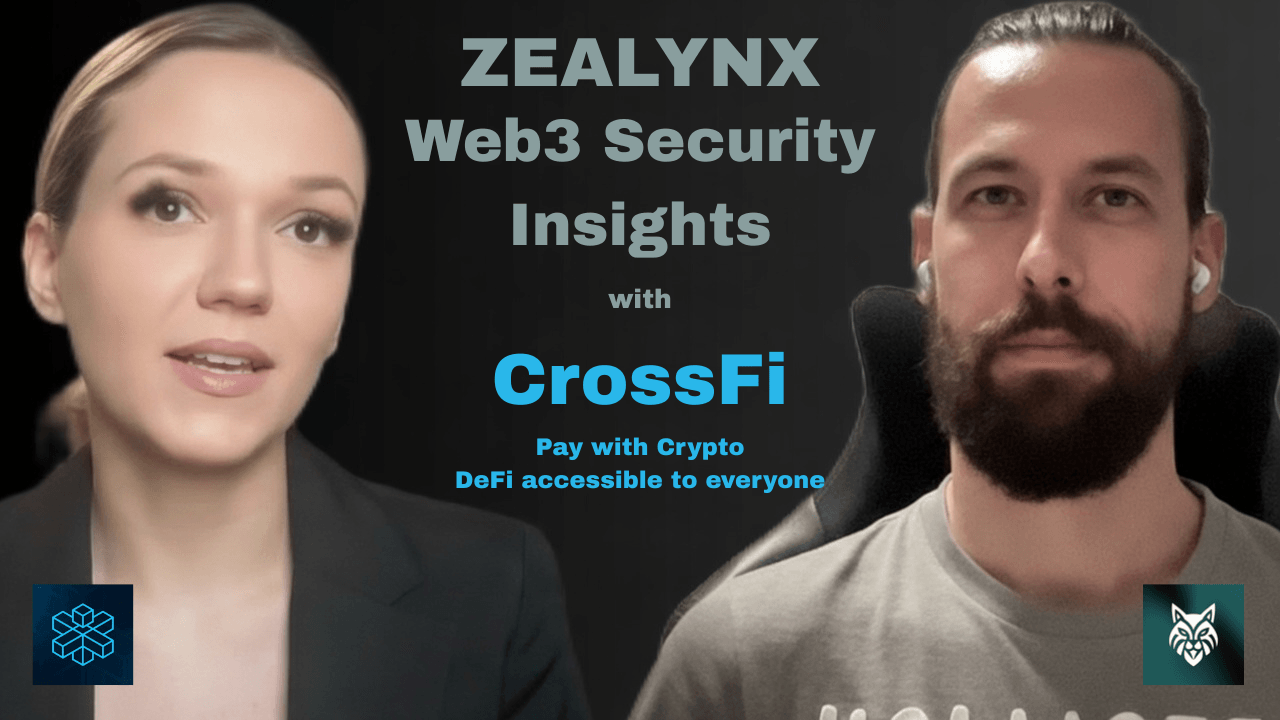

In the rapidly evolving landscape of decentralized finance (DeFi), building trust and providing user-friendly solutions is crucial for mass adoption.
In this article: You'll learn how CrossFi bridges traditional finance with DeFi through non-custodial Visa cards, the security model behind self-custody payments, and why this approach matters for mainstream crypto adoption.
In a recent episode of the Web3 Security Inside Series, Carlos from Zealynx Security speaks with Haley Cromer, Chief of Ecosystem and Partnerships at CrossFi, about how CrossFi is redefining the DeFi experience by integrating familiar financial tools with blockchain technology.
Watch the full episode:
Learn how CrossFi bridges traditional finance with DeFi through crypto Visa cards
and non-custodial banking solutions.
and non-custodial banking solutions.
Understanding CrossFi: The first Web3 bank
At its core, CrossFi aims to bridge traditional finance with the world of crypto, positioning itself as the first Web3 bank. Haley Cromer explains that the platform combines decentralized infrastructure with user-friendly financial tools like payments, cards, and fiat on-ramps.
This innovative approach allows users to engage with DeFi without the steep learning curve typically associated with blockchain technology. For instance, CrossFi users can make everyday purchases using crypto, whether it's paying rent or buying coffee, without needing in-depth blockchain knowledge.
By integrating traditional banking elements like Visa card payments into the decentralized ecosystem, CrossFi removes the complexity barrier that has long prevented mainstream adoption. Users maintain self-custody of their assets while enjoying the convenience of traditional payment rails.
The role of trust in DeFi adoption
One of the biggest barriers to entry in the crypto space is the unfamiliarity and complexity associated with it. By bringing traditional finance elements into the DeFi ecosystem, CrossFi helps lower these barriers significantly.
As Haley points out, integrating recognizable financial experiences, such as accepting Visa cards, enhances user comfort and trust in using decentralized systems. This familiarity, coupled with the transparency and self-custody benefits of blockchain, allows users to transition confidently into the decentralized finance realm.
Key trust factors:
- Familiar interfaces: Traditional card-based payments that users already understand
- Regulatory compliance: Working within existing financial frameworks
- Transparent operations: Blockchain-based verification without sacrificing user experience
- Non-custodial architecture: Users retain control of their assets at all times
Building partnerships and expanding reach
Scaling in the DeFi space is not without its challenges. Haley discusses how CrossFi focuses on non-custodial services to maintain user freedom and security. The company actively seeks partnerships and collaborates with other blockchain initiatives to enhance its offerings.
For example, by participating in hackathons and community events like ETH Toronto, CrossFi builds its reputation as a serious player in the EVM chain market. This grassroots approach to partnership and community building is essential for the company's growth and credibility.
Partnership strategies:
- Developer engagement: Hackathons and technical workshops
- Protocol integrations: Seamless connections with major DeFi platforms
- Community building: Active participation in ecosystem events
- Cross-chain compatibility: Supporting multiple blockchain networks
Navigating funding challenges in the current climate
Fundraising in the current climate poses additional challenges for emerging DeFi projects. Haley shares insights into CrossFi's approach to securing funding, especially as they prepare for their Series A round.
While the market is competitive, there is still considerable interest in their product, with their intellectual property valued at over a billion dollars. However, the process of raising capital has become more complex, with investors being more selective and wanting to thoroughly vet opportunities before committing.
Funding landscape considerations:
- Product-market fit: Demonstrating real user adoption and utility
- Security infrastructure: Comprehensive audits and security measures
- Sustainable business model: Clear path to profitability and growth
- Team expertise: Proven track record in DeFi and traditional finance
Security considerations for crypto payment cards
While CrossFi's approach offers convenience, understanding the security architecture is crucial. The platform's non-custodial design means users maintain control of their private keys, unlike traditional custodial exchanges where the platform controls your assets.
Security features:
- Self-custody wallets: Users control their private keys
- Smart contract security: Audited protocols for transaction processing
- Regulatory compliance: Operating within legal frameworks for payment processing
- Multi-signature protocols: Additional security layers for high-value transactions
Get the DeFi Protocol Security Checklist
15 vulnerabilities every DeFi team should check before mainnet. Used by 30+ protocols.
No spam. Unsubscribe anytime.
Conclusion
CrossFi is at the forefront of merging traditional finance with decentralized finance, making it easier for users to engage with crypto in a familiar way. By prioritizing user education and delivering a seamless experience, CrossFi is well-positioned to lead the charge in DeFi adoption.
Key takeaways:
- Trust is paramount: Familiar user experiences drive adoption in DeFi
- Strategic partnerships: Collaboration and community engagement fuel growth
- Funding challenges persist: Competitive landscape requires strong fundamentals
- Security architecture matters: Non-custodial designs protect user sovereignty
Partner with Zealynx for DeFi security
At Zealynx, we specialize in auditing DeFi protocols, payment systems, and blockchain infrastructure. Whether you're building the next generation of crypto payment solutions or need a comprehensive security audit for your Web3 banking platform, our team provides expert guidance to ensure your protocol is secure and production-ready.
Stay ahead with more insights on Web3 security and DeFi innovations—subscribe to our newsletter.
FAQ: Understanding crypto payments and DeFi banking
1. What is DeFi and how does it differ from traditional finance?
DeFi (Decentralized Finance) refers to financial services built on blockchain technology that operate without traditional intermediaries like banks or brokerages. Unlike traditional finance where institutions control your assets and transactions, DeFi protocols use smart contracts to automate financial operations on public blockchains like Ethereum. This means you maintain direct control over your assets (self-custody), transactions are transparent and verifiable on-chain, and services are accessible to anyone with an internet connection without requiring permission from centralized authorities.
2. What does non-custodial mean and why is it important?
A non-custodial service means you retain full control of your private keys and crypto assets—no third party can access, freeze, or confiscate your funds. This is critical because it eliminates counterparty risk: you don't have to trust a company to safeguard your assets, as seen in exchange collapses like FTX. With non-custodial solutions like CrossFi, you're the sole owner of your crypto, and the platform simply provides the infrastructure to interact with blockchain networks. The trade-off is that you're responsible for securing your private keys—if you lose them, there's no "password reset" option.
3. How do crypto Visa cards work with blockchain technology?
Crypto Visa cards bridge blockchain assets with traditional payment networks by automatically converting your cryptocurrency into fiat currency (like USD or EUR) at the point of purchase. When you make a payment, the card provider's system initiates a crypto-to-fiat swap, settles with Visa's network in fiat, and the merchant receives traditional currency—they never interact with blockchain directly. This allows you to spend crypto anywhere Visa is accepted while maintaining the merchant's familiar payment experience. The conversion happens in milliseconds, making the experience seamless for both parties.
4. What are smart contracts and why do they matter for payment security?
Smart contracts are self-executing programs stored on a blockchain that automatically enforce agreed-upon rules without requiring intermediaries. In the context of crypto payments, smart contracts handle tasks like verifying balances, executing token swaps, enforcing spending limits, and processing transactions according to predefined logic. They matter for security because the code is immutable (can't be changed after deployment) and transparent (anyone can audit it), reducing the risk of fraud or manipulation. However, this also means vulnerabilities in smart contract code can be exploited, which is why thorough auditing is critical before deployment.
5. What is an EVM chain and why does it matter for DeFi platforms?
EVM (Ethereum Virtual Machine) chains are blockchains that are compatible with Ethereum's programming environment, allowing them to run the same smart contracts and DApps. Beyond Ethereum itself, this includes networks like Polygon, Arbitrum, Optimism, BNB Chain, and Avalanche. For DeFi platforms like CrossFi, EVM compatibility is crucial because it enables: (1) access to Ethereum's massive developer ecosystem and existing protocols, (2) interoperability with other EVM chains through bridges, and (3) the ability to leverage battle-tested security tools and auditing frameworks. This compatibility accelerates development and allows users to move assets seamlessly across multiple networks.
6. What risks should users consider when using crypto payment cards?
While crypto payment cards offer convenience, users should understand several risks: (1) Volatility risk: Crypto prices fluctuate, so the value of your holdings may change between when you load funds and when you spend them. (2) Security risk: If your wallet is compromised, funds can be stolen with no recourse (unlike credit cards with fraud protection). (3) Regulatory risk: Crypto regulations vary by jurisdiction and may change, potentially affecting service availability. (4) Smart contract risk: Bugs in the underlying code could lead to loss of funds. (5) Conversion fees: Crypto-to-fiat conversions often include spreads or fees that reduce purchasing power. To mitigate these risks, use platforms with proven security audits, enable all available security features (2FA, multi-sig), and only keep spending amounts on hot wallets while storing larger holdings in cold storage.
Glossary
| Term | Definition |
|---|---|
| Self-Custody | Maintaining direct control of cryptocurrency private keys without relying on third-party custodians. |
| Fiat On-Ramp | Service enabling users to convert traditional currency into cryptocurrency. |
| Private Key | Cryptographic secret proving ownership and enabling spending of cryptocurrency assets. |
| Payment Rails | Underlying infrastructure and networks facilitating fund transfers between parties. |
Get the DeFi Protocol Security Checklist
15 vulnerabilities every DeFi team should check before mainnet. Used by 30+ protocols.
No spam. Unsubscribe anytime.