Private Key
Cryptographic secret that proves ownership and enables spending of cryptocurrency assets on blockchain networks.
Private Keys are cryptographic secrets—typically 256-bit numbers—that prove ownership and authorize spending of cryptocurrency assets on blockchain networks. Possession of a private key grants complete control over associated addresses and their funds. In cryptocurrency's security model, "not your keys, not your coins" captures the fundamental reality that private key possession, not account balances or legal claims, constitutes true ownership. This cryptographic sovereignty enables self-custody but requires users to secure secrets that, if compromised or lost, result in total asset loss with no recovery mechanism.
The mathematical foundation uses elliptic curve cryptography (specifically secp256k1 for Bitcoin/Ethereum). A private key generates a corresponding public key through one-way mathematical operations—anyone can compute the public key from a private key, but reversing this computation to derive the private key from a public key is computationally infeasible. Public keys hash to create addresses where others send funds. Only the private key holder can create valid signatures proving authorization to spend those funds.
Key Generation and Security
Cryptographic randomness is critical for secure private key generation. Keys must be truly random—predictable or weak randomness enables attackers to guess keys through brute force or pattern exploitation. Quality wallets use cryptographically secure random number generators (CSRNGs) seeded from system entropy. Flawed RNG implementations have caused catastrophic losses, as with the blockchain.info Android wallet bug where insufficient randomness enabled private key prediction.
BIP39 seed phrases (also called recovery phrases or mnemonic phrases) represent private keys in human-readable form. Rather than managing raw hexadecimal keys, users backup 12-24 word phrases from standardized dictionaries. These phrases mathematically derive all private keys for a wallet through hierarchical deterministic (HD) key generation (BIP32/BIP44). A single seed phrase can generate billions of unique private keys deterministically, enabling comprehensive wallet recovery from one backup.
The article mentions CrossFi users maintaining "control of their private keys" through "self-custody wallets." This architecture means users—not CrossFi—possess the cryptographic secrets authorizing transactions. While CrossFi provides payment card infrastructure, the underlying crypto assets remain under private key control, preserving user sovereignty despite integration with traditional payment networks.
Storage Methods and Attack Vectors
Hot wallets store private keys on internet-connected devices (phones, computers, browsers). Software wallets like MetaMask, Trust Wallet, and Exodus offer convenient access but expose keys to malware, phishing, and remote attacks. Encrypted storage provides some protection, but sophisticated malware can capture decryption passwords through keyloggers or memory scanning. Hot wallets are appropriate for spending amounts—funds you're willing to risk for transaction convenience—not long-term holdings.
Cold storage keeps private keys offline, isolated from internet exposure. Hardware wallets like Ledger and Trezor generate and store keys on dedicated devices never directly connected to the internet. Transaction signing occurs on the hardware wallet, with signed transactions transferred to connected computers for broadcasting. This isolation protects against remote attacks—even if the connected computer is compromised, attackers cannot extract keys from the hardware device.
Paper wallets represent the original cold storage method—printing private keys or QR codes on paper. While eliminating digital attack vectors, paper wallets introduce physical security concerns: fire, water damage, fading ink, or simple loss can destroy keys permanently. Modern best practices favor hardware wallets or metal plate backups (engraved seed phrases resistant to environmental damage) over paper.
Cloud storage of private keys or seed phrases is universally considered dangerous. Even encrypted cloud storage creates attack surfaces: cloud account compromise, provider breaches, or government data requests can expose keys. The fundamental principle is that private keys should never exist in digitally-connected form except during active use in secure wallet applications.
Cryptographic Operations and Signing
Digital signatures prove transaction authorization without revealing private keys. When spending crypto, wallets create signatures by combining the private key with transaction data through elliptic curve math. Blockchain nodes verify signatures using the corresponding public key, confirming the private key holder authorized the transaction without the private key ever being transmitted or revealed. This zero-knowledge proof enables secure transaction authorization over public networks.
Transaction signing typically involves these steps: wallet software constructs the transaction (recipient address, amount, fees), presents it to the user for approval, user confirms, and the wallet uses the private key to generate a signature. This signature gets attached to the transaction and broadcast to the network. Miners/validators verify the signature's validity before including the transaction in blocks. Invalid signatures (wrong key, tampered transaction data) get rejected, preventing unauthorized spending.
The article discusses CrossFi's "smart contract security" and transaction processing. When users make purchases with CrossFi's crypto Visa card, the underlying crypto-to-fiat conversion likely involves automated transaction signing using the user's private keys (or keys they've delegated specific permissions to). The security architecture must ensure these automated signings can only occur for legitimate purchases, not unauthorized transactions.
Key Derivation and HD Wallets
Hierarchical Deterministic (HD) wallets (BIP32) derive unlimited private keys from a single master seed. This eliminates the need to backup multiple keys—one seed phrase recovers the entire wallet hierarchy. HD wallets generate keys deterministically: the same seed always produces the same sequence of keys. This enables multiple addresses for privacy (new address per transaction) while maintaining simple backups.
Derivation paths (BIP44) standardize how HD wallets organize keys. Different cryptocurrencies and account purposes use specific path patterns: m/44'/0'/0'/0/0 for Bitcoin's first receiving address, m/44'/60'/0'/0/0 for Ethereum's first address. Understanding derivation paths matters when recovering wallets—using the wrong path with the correct seed won't find your funds.
Extended keys (xpub/xprv) enable interesting capabilities. An extended public key (xpub) can generate all public addresses in a wallet hierarchy without accessing private keys. This enables watch-only wallets for monitoring balances, or allowing a server to generate deposit addresses without holding withdrawal keys. Extended private keys (xprv) generate both public addresses and private keys—compromising an xprv exposes all wallet funds.
Multi-Signature and Threshold Schemes
Multi-signature wallets require M-of-N private key signatures to authorize transactions. A 2-of-3 multisig holds three private keys (typically spread across different locations/devices) but only needs two to sign transactions. This provides backup redundancy (losing one key doesn't lock funds) and security enhancement (compromising one key doesn't enable theft). The article mentions CrossFi using "multi-signature protocols" for high-value transactions, suggesting institutional-grade security for critical operations.
Threshold signatures (TSS) achieve similar goals through different cryptography. Rather than multiple complete private keys, TSS splits a single private key into shares where M-of-N shares combine to generate valid signatures. This offers multisig security benefits (distributed control, no single point of failure) while appearing as single-signature transactions on-chain, saving gas and maintaining privacy.
Loss and Recovery Scenarios
Irreversible loss distinguishes crypto from traditional finance. Lost private keys mean permanently inaccessible funds—no password reset, no customer service recovery. Billions in Bitcoin remain provably unspent in addresses with lost keys. The article notes "if you lose them, there's no 'password reset' option" regarding private key responsibility, emphasizing the critical importance of secure backups.
Seed phrase compromise enables complete wallet takeover. Anyone obtaining your seed phrase gains permanent access to all associated addresses and funds across all derived keys. Unlike passwords that can be changed, compromised seeds require emergency evacuation—immediately transferring all assets to new wallets with new seeds. The compromised seed remains permanently unsafe for future use.
Social recovery mechanisms attempt to balance security and recoverability. Protocols like Argent enable designating trusted guardians who collectively can authorize account recovery if keys are lost. This reduces loss risk while introducing trust dependencies—chosen guardians must be reliable and uncompromised. The approach suits users prioritizing recoverability over pure self-custody sovereignty.
Private Key Best Practices
Physical security for seed phrase backups is paramount. Write seed phrases on durable materials (metal plates resist fire/water), store in secure locations (fireproof safes, safety deposit boxes), and never photograph or digitize. Some users split seeds across multiple geographic locations, though this increases complexity and partial compromise risk.
Operational security during key generation and use prevents attacks. Generate keys on devices never connected to the internet, verify wallet software authenticity before use, and maintain device security through updated software and antivirus protection. The blind signing vulnerability discussed in other articles is particularly relevant—users must verify transaction details before signing, as malware could display false information while tricking users into signing malicious transactions.
Testing and verification before substantial fund transfers is essential. Send small test amounts to new addresses before large transfers, verify recovery from seed phrases on separate devices, and document derivation paths used. Many losses occur from untested assumptions about how wallets work—discovering recovery failures after losing device access is too late.
Understanding private keys is foundational to cryptocurrency security and self-custody. The article's emphasis on CrossFi's "non-custodial design" where users "maintain control of their private keys" reflects private key ownership as the defining characteristic of true crypto ownership versus custodial services where platforms control keys. While this responsibility creates risks—loss, theft, operational mistakes—it also provides the sovereignty, censorship resistance, and independence from intermediaries that distinguish cryptocurrency from traditional finance. Private key management defines the tradeoff between convenience and control at cryptocurrency's core.
Articles Using This Term
Learn more about Private Key in these articles:
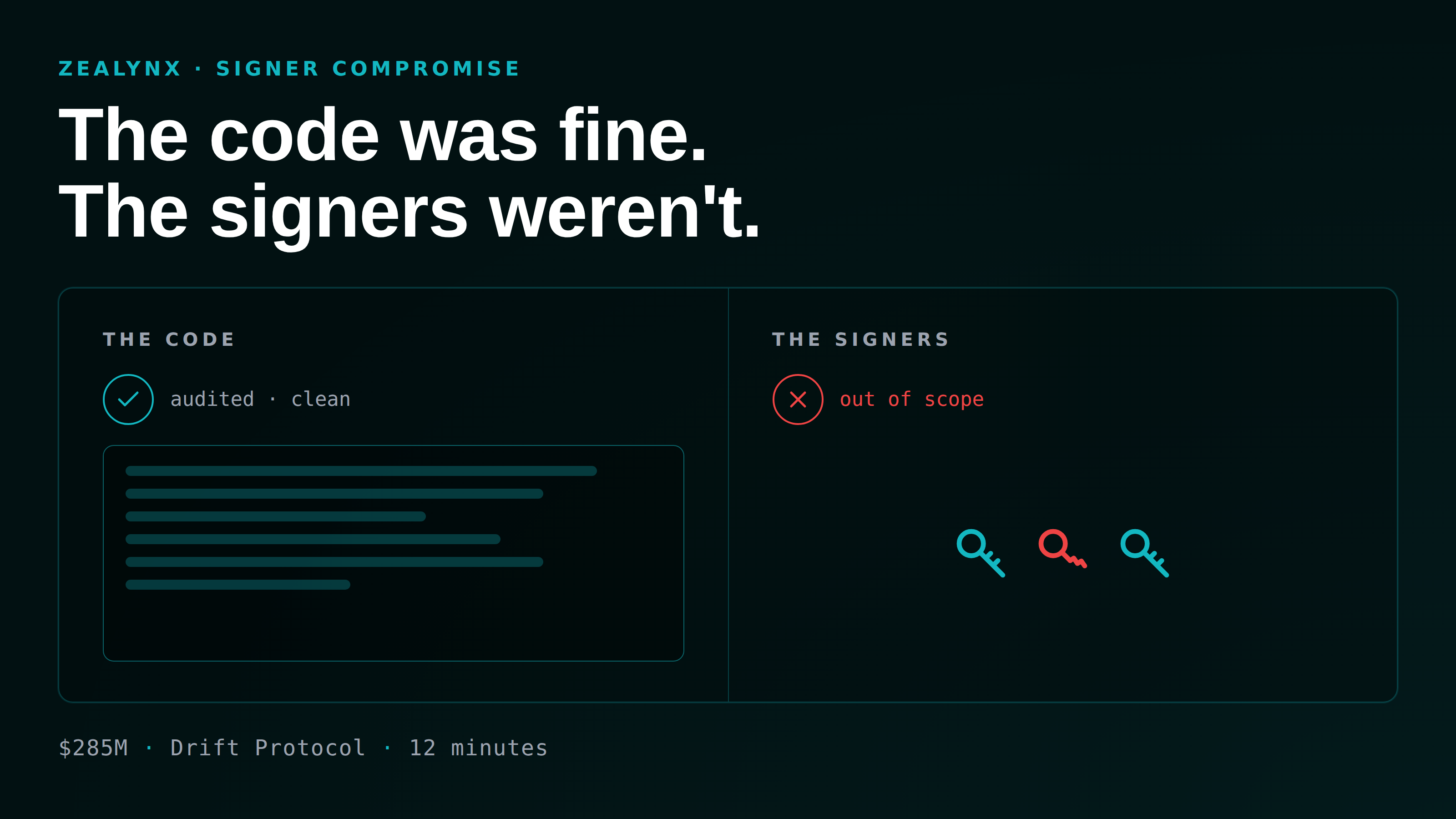
Signer compromise: why clean audits don't stop key hacks
Most 2026 DeFi losses came from compromised signers, not buggy code. How multisig, timelocks, and MPC contain key compromise — lessons from Drift's $285M hack.
Are Crypto Payments with CrossFi's Visa Card Safe?
Discover how CrossFi bridges traditional finance and DeFi with crypto Visa cards, enabling secure everyday payments while maintaining decentralization and user control over digital assets.
Related Terms
Self-Custody
Maintaining direct control of cryptocurrency private keys without relying on third-party custodians like exchanges or banks.
Hardware Wallet
A physical device that stores cryptocurrency private keys offline, providing enhanced security against remote attacks.
Multi-signature Wallet
A cryptocurrency wallet requiring multiple private key signatures to authorize transactions, distributing trust.
Need expert guidance on Private Key?
Our team at Zealynx has deep expertise in blockchain security and DeFi protocols. Whether you need an audit or consultation, we're here to help.
Get a Quote