Multi-signature Wallet
A cryptocurrency wallet requiring multiple private key signatures to authorize transactions, distributing trust.
Multi-signature Wallets (multisig) are cryptocurrency custody solutions that require multiple private key signatures to authorize transactions, distributing control across several parties rather than concentrating it in a single key holder. This architecture eliminates single points of failure, provides protection against compromised keys, and enables governance structures that require consensus before executing operations with protocol funds.
The most widely adopted multisig implementation for Ethereum is Safe (formerly Gnosis Safe), which manages hundreds of billions of dollars in assets for DAOs, protocols, and institutional users. Safe implements on-chain multisig logic through smart contracts that enforce signature requirements, track pending transactions, and provide a user interface for proposal creation and approval workflows. Other implementations include Coinbase Multisig for institutional custody and native Bitcoin multisig using P2SH addresses.
Architecture and Security Model
A multisig wallet is defined by its threshold signature scheme, typically expressed as M-of-N where M signatures from N total signers are required to authorize transactions. A 2-of-3 multisig requires two signatures from three designated key holders, while a 5-of-9 multisig requires five signatures from nine authorized signers. The threshold and signer set are defined during wallet creation and can typically be modified through transactions that meet the existing threshold requirement.
The fundamental security property is distributed trust. Unlike single-key wallets where compromise of one private key grants complete control over funds, multisig requires attackers to compromise multiple independent keys simultaneously. For a properly configured multisig, this requires attacking multiple people, organizations, or custody solutions—a dramatically higher barrier than single-key attacks. This makes multisig essential for organizations managing significant cryptocurrency holdings.
However, the Bybit incident of 2025 demonstrated that multisig alone cannot prevent sophisticated attacks. Despite using multisig custody with multiple hardware wallet signers, Bybit lost $1.5 billion when attackers compromised the front-end interface used by all signers. Each signer independently verified what appeared to be legitimate transactions on their hardware wallet screens, not realizing the underlying transaction data had been substituted. This illustrates that multisig distributes key management, not necessarily verification procedures.
Implementation Patterns and Governance
Organizations implement multisig wallets with thresholds and signer sets designed for their specific security and operational requirements. Operational multisigs for day-to-day protocol management might use 2-of-3 or 3-of-5 thresholds, balancing security against the need for timely execution. Low thresholds relative to signer count maintain operational flexibility even if some signers are unavailable, but reduce security margins against compromised keys.
Treasury multisigs holding protocol reserves or DAO funds typically use higher thresholds like 4-of-7 or 6-of-9, prioritizing security over operational speed. These configurations can tolerate compromise of nearly half the signers without losing funds, providing substantial safety margins. The trade-off is increased coordination overhead—more signers must be contacted and approve each transaction, slowing execution.
Emergency response multisigs often use lower thresholds like 2-of-5 to enable rapid action during security incidents while maintaining distributed control. These wallets might hold admin keys for protocol pause functions or emergency withdrawal capabilities, where the operational requirement for speed justifies reduced security margins. The signer set typically includes on-call security team members who can respond quickly to incidents.
Operational Security Considerations
Effective multisig security requires addressing both cryptographic and operational attack vectors. Signer independence ensures that compromising one signer's security doesn't automatically compromise others. Each signer should use different hardware wallet brands, operate on different devices and networks, use different password managers, and ideally be in different physical locations. This diversity prevents single vulnerabilities from affecting multiple signers simultaneously.
Signing verification procedures must be standardized across all signers to prevent blind signing attacks. Organizations should mandate that each signer independently verifies transaction details using different tools—one might use the Safe interface, another uses Etherscan's transaction decoder, and a third uses command-line tools like Cast. This diversity prevents compromised interfaces from affecting all signers' verification processes.
Transaction initiation controls determine who can propose transactions for multisig approval. Some implementations allow anyone to propose transactions (only execution requires signatures), while others restrict proposal creation to signers or specific addresses. Unrestricted proposal creation can enable social engineering attacks where attackers submit legitimate-looking transactions hoping careless signers approve without thorough verification. Organizations should implement proposal allowlisting or restrict proposal creation to authorized addresses.
Advanced Patterns and Timelocks
Timelocked multisigs add a delay between transaction proposal and execution, creating a window for detection and response. Protocols might require that multisig transactions wait 24-48 hours after receiving sufficient signatures before execution, allowing the community to review proposed changes and raise concerns if the transaction appears malicious. This pattern is particularly important for protocol governance multisigs that control upgradeable contracts or critical parameters.
Nested multisigs distribute control across multiple organizational layers. A DAO might have a 5-of-9 multisig where three of the signers are themselves 2-of-3 multisigs controlled by different teams. This enables sub-organizations to participate in top-level governance while maintaining internal consensus requirements. The complexity introduces additional security margins but significantly increases operational overhead.
Social recovery schemes allow multisig wallet owners to designate recovery guardians who can collectively restore access if the owner loses their primary keys. Implementations like Argent use multisig-like mechanisms for recovery where guardians (trusted friends, family, or professional services) can approve recovery transactions after appropriate verification procedures. This prevents permanent fund loss from key loss while maintaining security against unauthorized recovery attempts.
Integration with Hardware Wallets
The combination of multisig schemes and hardware wallets provides industry best practice for cryptocurrency custody. Each signer uses a hardware wallet to store their private key, providing protection against software attacks, while the multisig threshold ensures that compromise of any single hardware wallet doesn't compromise the funds. Organizations should standardize on hardware wallet usage for all multisig signers.
For maximum security, signers should use diverse hardware wallet models rather than identical devices. If a vulnerability is discovered in a specific hardware wallet model, a multisig using different brands for different signers remains secure as long as the number of compromised devices stays below the signing threshold. This hardware diversity complements the operational diversity in verification procedures.
Understanding multi-signature wallets requires recognizing that they distribute trust and control but don't eliminate the need for rigorous security practices. Each signer must implement proper verification procedures, maintain secure key storage, and follow operational security protocols. The Bybit incident demonstrated that even sophisticated multisig implementations remain vulnerable to attacks that compromise the transaction verification process rather than the cryptographic keys themselves. Effective multisig security requires combining distributed key management with diverse, independent verification procedures and strong operational security practices across all signers.
Articles Using This Term
Learn more about Multi-signature Wallet in these articles:
Blind Signing: The Bybit $1.5B Lesson in UI Insecurity
Technical analysis of the largest crypto hack ($1.5B). How compromised frontend infrastructure enabled UI injection that turned blind signing into a total drain.
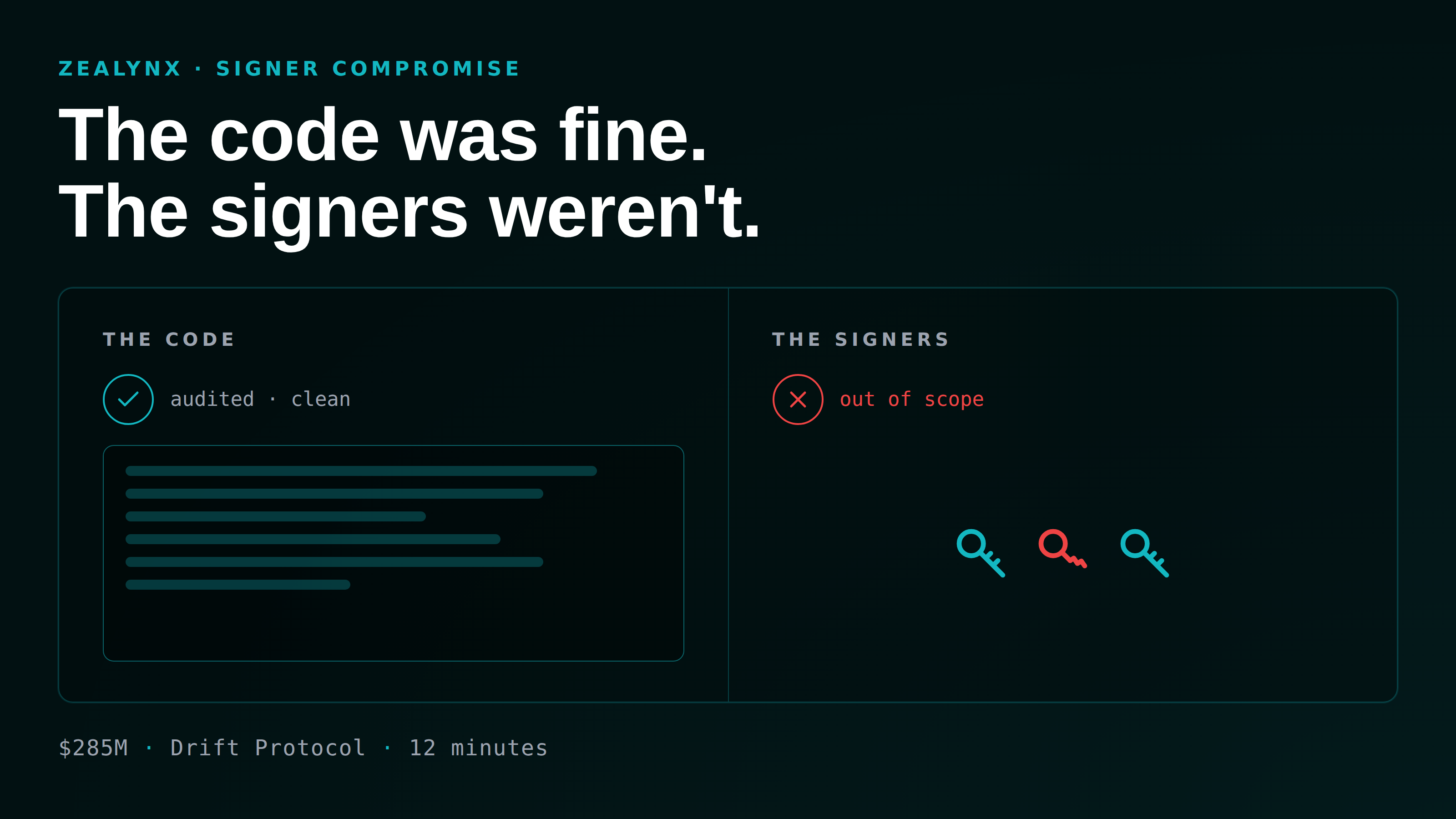
Signer compromise: why clean audits don't stop key hacks
Most 2026 DeFi losses came from compromised signers, not buggy code. How multisig, timelocks, and MPC contain key compromise — lessons from Drift's $285M hack.
2025 DeFi Hacks: $3.4B Exploit Lessons You Must Know
$3.4B lost in 2025: Bybit, Cetus, Balancer breakdowns. Zealynx auditors explain blind signing, supply chain attacks, and how to close audit blind spots.
Related Terms
Need expert guidance on Multi-signature Wallet?
Our team at Zealynx has deep expertise in blockchain security and DeFi protocols. Whether you need an audit or consultation, we're here to help.
Get a Quote