Back to Blog 
 \"M3D"
AuditWeb3 Security
How Smart Contract Audits Boost Gas Savings and Market Cap: Real ROI Insights
7 min
You’ve been heads-down in the codebase for months. The logic is tight, the tests are passing, and the community is clamoring for a mainnet launch. Then comes the friction: the security audit.
It’s expensive. It’s slow. It feels like a "security tax" paid to external firms to tell you what you think you already know. In the current Web3 landscape, where $2.2 billion was lost to exploits in 2024 alone, the audit is often viewed as a binary "safe/unsafe" stamp.
But looking at an audit as a cost center is a fundamental misunderstanding of protocol unit economics. For a technical lead, the audit isn’t just about avoiding a catastrophic "zero-day"; it’s a tool for optimizing capital efficiency, reducing user churn via gas savings, and building a legal "standard of care."
Here is how to quantify the actual ROI of security beyond the fear of a hack.
1. The stakeholder formula: Justifying the spend
When you need to argue for a $100k+ security budget to a non-technical founder or a DAO treasury, "we might get hacked" is often too abstract. You need to frame it as an insurance premium against an asymmetric risk.
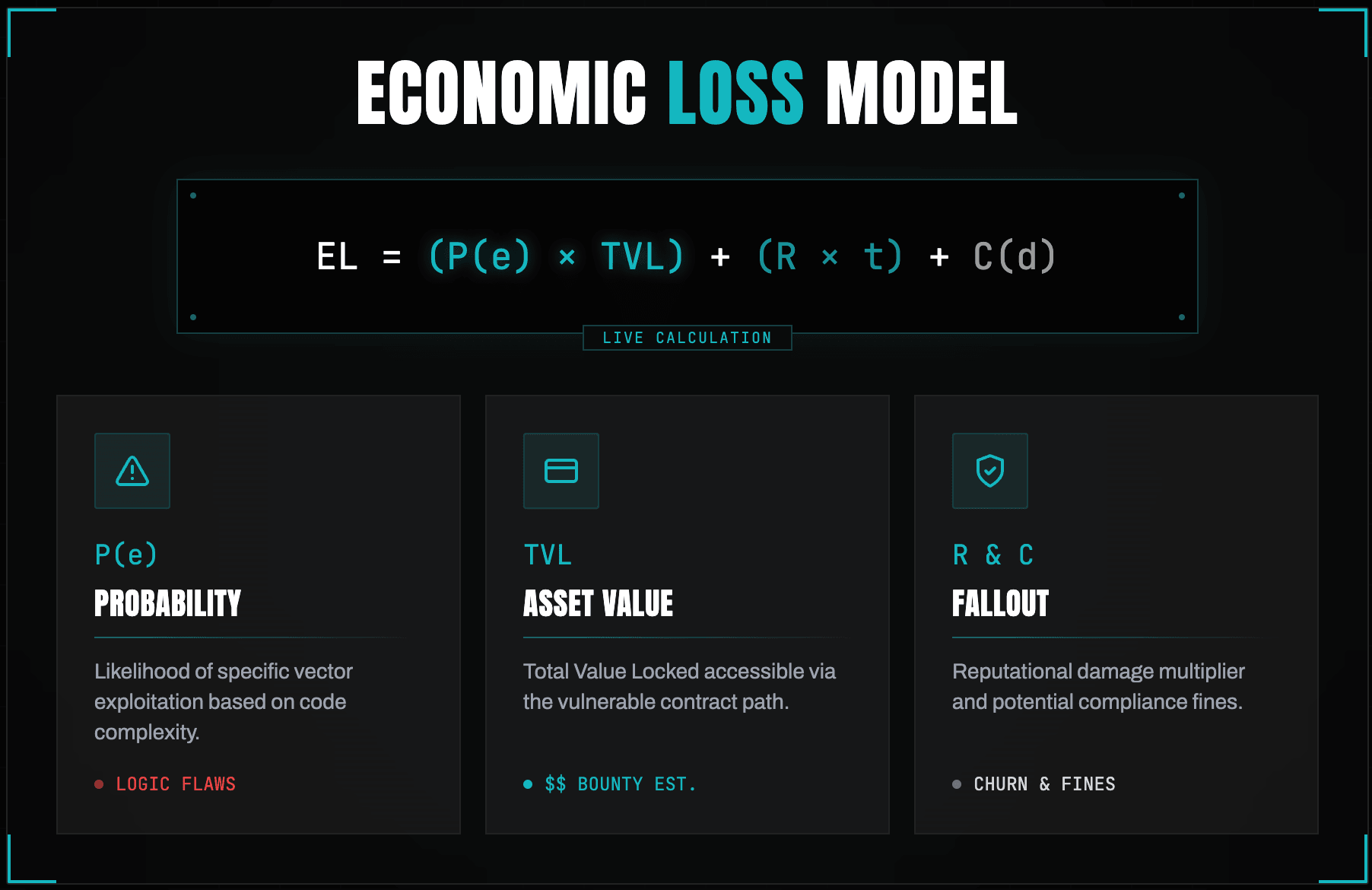
You can use this formula to calculate the Expected Loss (EL) of a non-audited protocol:
EL = (P(e) × TVL) + (R × t) + C(d)
- P(e): Probability of exploit (Based on 2024 data, 75% of losses stemmed from access control and logic flaws—risks an audit specifically targets).
- TVL: Total Value Locked (The bounty for the attacker).
- R × t: Reputation damage over time (Churn rate of users post-exploit).
- C(d): Cost of remediation (Deploying fixes, legal fees, and potential MiCA compliance fines in the EU).
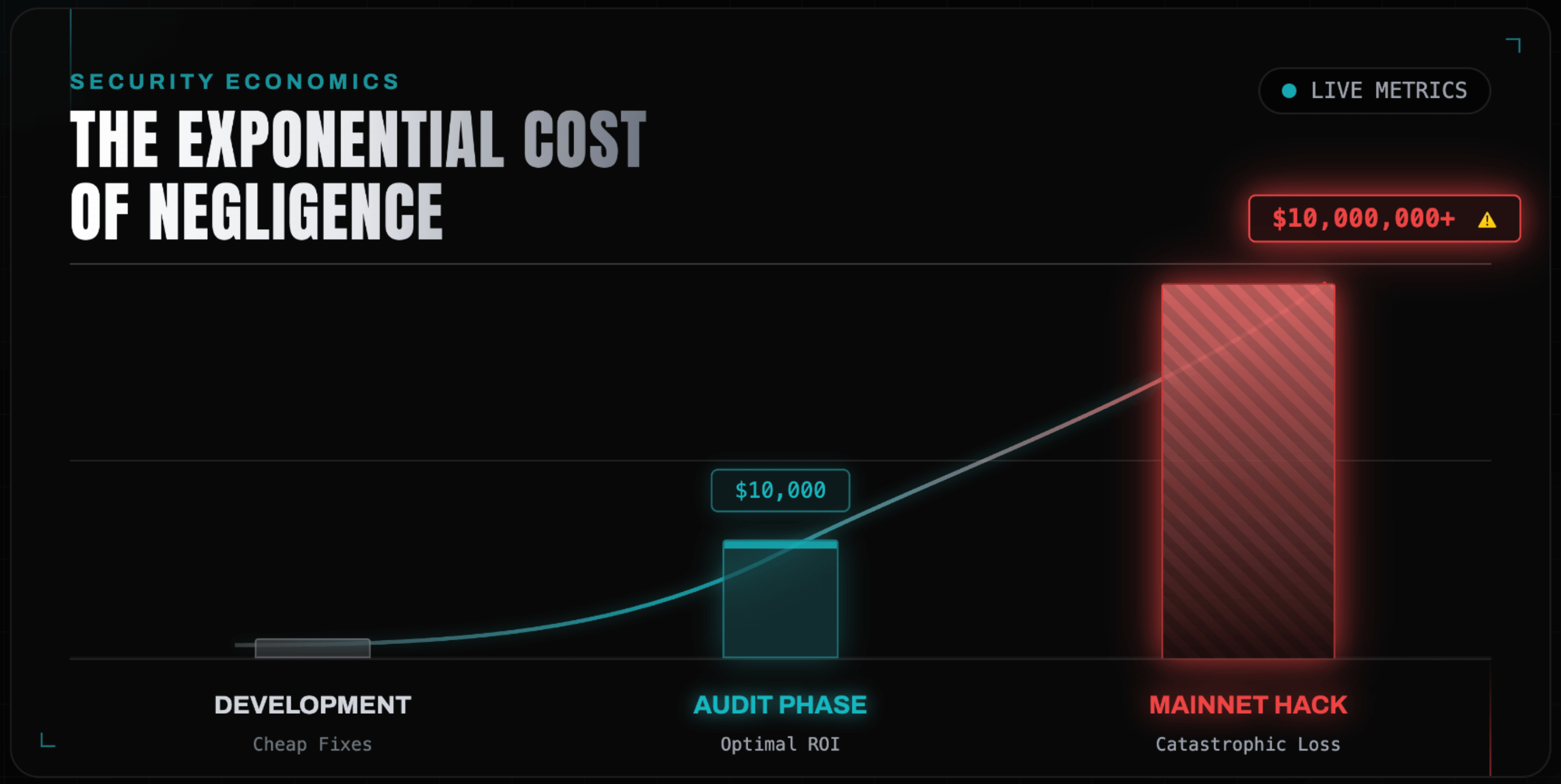
The Reality: For a protocol with $100M in TVL, a $100k audit represents 0.1% of assets. A mid-tier exploit (losing 10% of funds) results in a $10M loss. The ROI on preventing that single event is 10,000%.
2. The "silent" ROI: Gas optimization as a user subsidy
A high-quality audit is essentially a peer review by EVM specialists. Beyond finding vulnerabilities, they often identify architectural inefficiencies that cost your users money every time they interact with your contract.
Consider these common optimizations found during professional reviews:
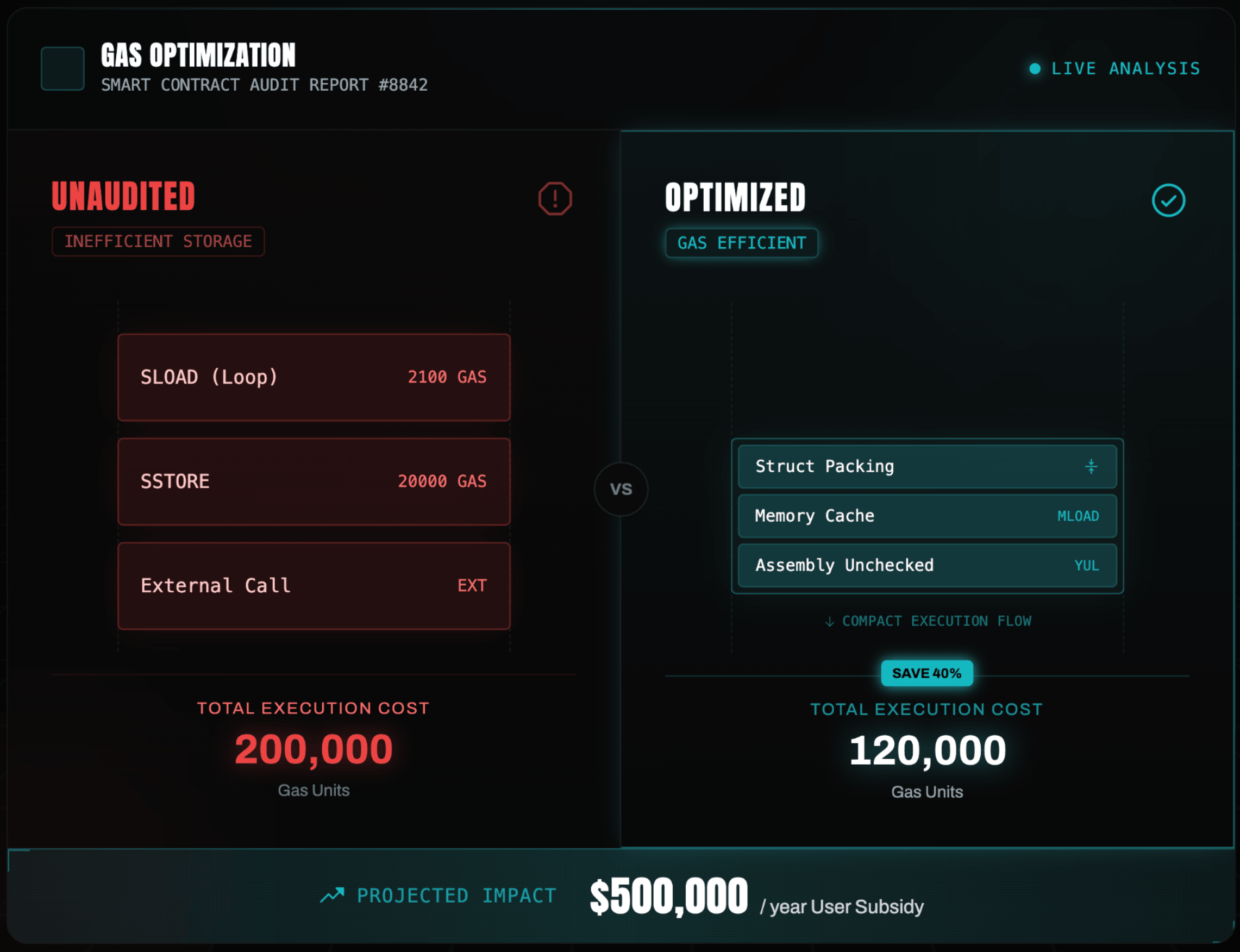
- SLOAD vs. MLOAD: Repeatedly reading from storage is expensive. An auditor might find instances where caching a value in memory (MLOAD) instead of storage (SLOAD) saves 2,100 gas per call.
- Struct Packing: Organizing variables into 32-byte slots can save 20,000 gas per slot by reducing
SSTOREoperations. - Unchecked Blocks: Identifying where overflows are mathematically impossible allows you to use
uncheckedarithmetic, shaving off gas on every loop iteration.
The Calculation: If an audit identifies optimizations that save $0.50 per transaction and your protocol handles 1 million transactions per year, you have just generated a $500,000 annual subsidy for your users. The audit pays for itself five times over in year one through improved UX and user retention.
3. The remediation gap: Pre-deployment vs. post-deployment
Fixing a bug while the code is in your IDE costs the salary of the developer for an hour. Fixing a bug after $50M is locked in a non-upgradable contract is an existential crisis.
- Post-deployment cost: Emergency "war room" hours, pausing the protocol (if possible), potential hard forks, or complex proxy migrations that risk further bugs.
- The "Standard of Care": Under frameworks like MiCA in the EU or emerging tort law in the US, an audit serves as evidence that you met the industry's "duty of care." Without it, developers face increased personal liability for "negligent" coding.
4. Company viewpoint: Audits are code reviews, not insurance
It is a mistake to view an audit as a "safety certificate." At Zealynx, we believe an audit is an intensive, adversarial peer review.
A "clean" report does not mean your code is bug-free; it means a specific set of experts couldn't break it within a specific timeframe. The highest ROI isn't found in the "Pass" mark, but in the knowledge transfer between the auditor and your team.
The goal isn't just to fix the bug—it's to understand the architectural flaw that allowed the bug to exist. We view security as a continuous lifecycle (Unit Tests → Formal Verification → Audit → Bug Bounty), not a one-time gate.
5. Summary of the competitive advantage
In the 2026 market, "Audit ROI" manifests in three "Gatekeeper" approvals:
- Exchange Listings: Tier-1 exchanges like Coinbase and Binance now mandate external security history as a prerequisite for liquidity.
- Institutional Capital: LPs and whales rarely deposit into "black box" contracts. An audit removes the ceiling on your TVL.
- Insurance Capacity: Protocols like Nexus Mutual price their premiums based on audit quality. Better audits = lower insurance costs for your users = more competitive yields.
Are you audit-ready?
Download the free Pre-Audit Readiness Checklist used by 30+ protocols preparing for their first audit.
No spam. Unsubscribe anytime.
Next step for technical leads
Before you book an audit, ensure your team has maximized the value of the auditor's time.
Read our Pre-Audit Technical Checklist to learn how to prepare your repo, document your invariants, and use static analysis tools to catch the "low-hanging fruit" so your auditors can focus on the complex logic flaws that actually matter.
Partner with Zealynx
At Zealynx, we view security as a profit driver, not a tax. We help you identify gas optimizations and logic flaws that others miss, turning your audit into a competitive advantage. Ensure your codebase is not just safe, but economically optimized for the 2025 market.
FAQ: Audit ROI & Economics
1. Why is an audit considered an investment rather than a cost?
An audit prevents catastrophic loss (potentially saving 100% of TVL) and reduces recurring operational costs like gas fees. When viewed through the Stakeholder Formula, the cost of an audit is a fraction of the potential Expected Loss from a hack or reputation damage.
2. How does gas optimization offset the cost of an audit?
Optimizations identified during an audit—such as efficient storage packing or using
unchecked arithmetic—can save users thousands of dollars annually. For high-volume protocols, these accumulated savings can exceed the initial audit fee within the first year, effectively "paying back" the cost.3. Can a lack of audit affect my token's market performance?
Yes. In 2025, top-tier exchanges (CEXs) and institutional investors view audits as a due diligence prerequisite. Without a reputable audit, you limit your access to liquidity pools and "smart money," effectively creating a ceiling on your project's market cap.
4. What is the "Remediation Gap"?
The Remediation Gap refers to the massive difference in cost between fixing a bug during development versus after deployment. Fixing a vulnerability pre-launch costs developer hours; fixing it post-launch can cost millions in lost funds, legal fees, and emergency migration efforts.
Glossary
| Term | Definition |
|---|---|
| Gas Optimization | Code efficiency improvements reducing transaction costs by minimizing computational operations. |
| Unchecked Arithmetic | Solidity optimization disabling overflow/underflow checks when mathematically safe. |
| Gas | Unit measuring computational effort required to execute transactions on Ethereum. |
Are you audit-ready?
Download the free Pre-Audit Readiness Checklist used by 30+ protocols preparing for their first audit.
No spam. Unsubscribe anytime.