Front-running
The practice of observing pending transactions and submitting similar transactions with higher gas fees to execute first, extracting value.
Front-running is a form of transaction ordering manipulation where an attacker observes pending transactions in the public mempool and strategically places their own transaction ahead of it to extract value.
How Front-Running Works
The Attack Mechanism
The front-running attack exploits the transparent nature of blockchain mempools. Attackers continuously monitor the mempool for profitable transactions, particularly large decentralized exchange trades that will move market prices significantly. Once identified, the attacker copies or crafts a related transaction and submits it with substantially higher gas fees, ensuring miners or validators prioritize their transaction for inclusion in the next block. By executing first, the attacker manipulates market conditions to their advantage and extracts value from the subsequent victim transaction.
Real-World Example in Decentralized Trading
Consider a scenario where a user submits a transaction to purchase 100 ETH worth of a particular token. An attacker observing the mempool sees this pending large buy order and immediately submits their own buy order for the same token with higher gas fees. The attacker's transaction executes first, purchasing tokens and driving up the price. When the victim's transaction finally executes, they receive tokens at this artificially inflated price. The attacker then sells their tokens at a profit in what's commonly known as a sandwich attack—bracketing the victim's transaction between a buy and sell.
Types of Front-Running Attacks
Displacement Attacks
Displacement front-running involves replacing a victim's transaction entirely by copying it with higher gas fees. This attack vector is particularly prevalent in NFT minting events, domain name registrations, and governance votes where being first provides exclusive access to a scarce resource. The attacker essentially steals the opportunity by outbidding the original submitter.
Insertion Attacks
Insertion front-running places a malicious transaction before the victim's transaction to manipulate contract state. This technique is commonly employed in DEX trades where price manipulation can generate profits, liquidation scenarios where being first to liquidate yields rewards, and oracle updates where stale prices can be exploited before they refresh.
Suppression Attacks
Suppression represents a more aggressive form of front-running where attackers deliberately delay victim transactions by flooding blocks with high-gas transactions. This tactic can prevent users from protecting positions before liquidation, block emergency defensive actions during exploits, or simply grief competitors in time-sensitive operations.
Protection Against Front-Running
Protocol-Level Defenses
Protocols can implement several architectural protections against front-running attacks. Slippage protection allows users to specify maximum acceptable price impacts, causing transactions to automatically revert if prices move beyond the specified threshold. This mechanism effectively caps the profit margin available to front-runners, making attacks less economically viable.
Private mempool services, such as Flashbots, provide an alternative transaction submission pathway that hides pending transactions from public view until block inclusion. While this approach significantly reduces front-running exposure, it does introduce potential centralization concerns that protocol designers must carefully weigh against the security benefits.
Commit-reveal schemes offer a cryptographic solution where users submit encrypted transaction details in a commitment phase, then reveal the actual transaction parameters only after a waiting period. This prevents attackers from observing transaction intent before execution, though it adds complexity and latency to the user experience.
User-Level Protections
Individual users also have several defensive strategies at their disposal. Setting reasonable slippage tolerances is critical—avoiding excessively high values like 2.5% creates tighter bounds that limit front-runner profits while maintaining reasonable execution certainty under normal market conditions.
Strategic gas pricing can reduce vulnerability by using competitive gas fees that minimize time spent in the mempool, making front-running attempts more expensive and less profitable for attackers. Additionally, trade size management through splitting large orders into smaller tranches reduces the per-transaction profit potential for attackers, though this approach may increase overall transaction costs through additional gas fees.
Economic Impact of Front-Running
Front-running effectively operates as an invisible tax on blockchain users, with estimates suggesting billions of dollars in extracted value annually across major networks. This value extraction degrades the overall user experience and creates systematic advantages for sophisticated actors with the technical infrastructure to monitor mempools and execute rapid responses. Beyond individual losses, widespread front-running may reduce overall market efficiency by introducing an adversarial layer between user intent and execution.
Relationship to Maximal Extractable Value
Front-running represents one component within the broader category of Maximal Extractable Value (MEV), which encompasses all forms of value extraction through strategic transaction ordering. Related MEV strategies include back-running (executing immediately after a target transaction), sandwich attacks (bracketing a victim transaction with both front-running and back-running), liquidation sniping where speed determines who captures liquidation rewards, and cross-protocol arbitrage opportunities that arise from temporary price discrepancies. Understanding front-running is essential for grasping the full MEV landscape and its implications for decentralized finance security.
Articles Using This Term
Learn more about Front-running in these articles:
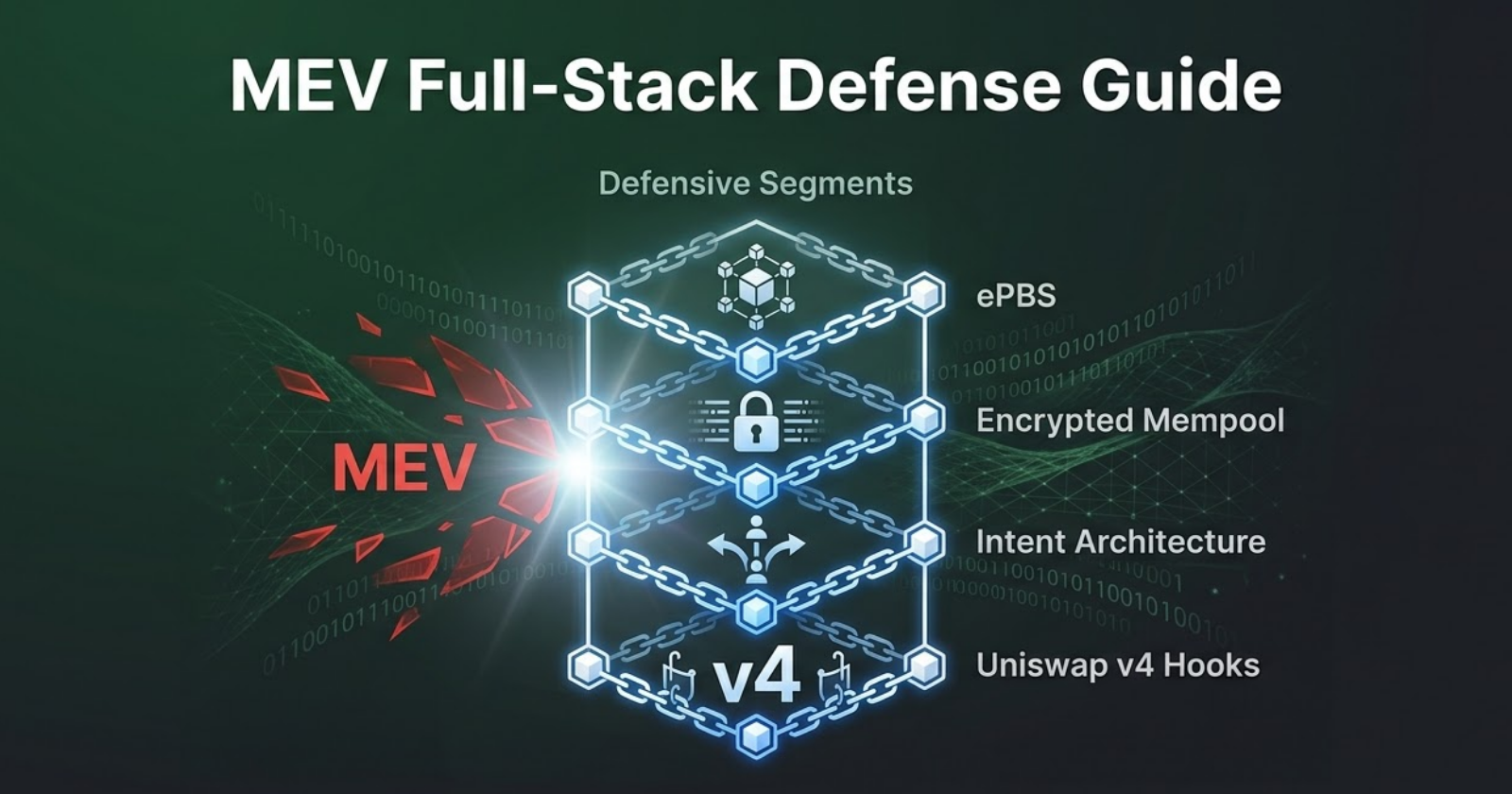
How to protect your DeFi protocol from MEV: A full-stack defense guide
Learn how to defend your DeFi protocol from sandwich attacks and MEV extraction with PBS, encrypted mempools, intent architectures, and Uniswap v4 hooks.
Uniswap V1: How the First AMM Worked (& Its Flaws)
How Uniswap V1 invented the AMM: x*y=k invariant, ETH-only pools, and the price manipulation gaps that V2 had to fix. Security-first code analysis.
Related Terms
Need expert guidance on Front-running?
Our team at Zealynx has deep expertise in blockchain security and DeFi protocols. Whether you need an audit or consultation, we're here to help.
Get a Quote