Program Derived Address (PDA)
A deterministic address derived from a combination of seeds and a program ID that falls off the Ed25519 curve, allowing programs to sign transactions without a private key.
A Program Derived Address (PDA) is a special type of account address on Solana that is deterministically derived from a set of seeds and a program's ID. Unlike regular Solana addresses, PDAs are guaranteed to not lie on the Ed25519 elliptic curve, which means no private key exists for them. This property allows programs to "sign" for these addresses during Cross-Program Invocations (CPIs) using invoke_signed.
How PDAs are derived
PDA derivation uses the Pubkey::find_program_address function, which takes an array of seed bytes and a program ID:
1let (pda, bump) = Pubkey::find_program_address(2 &[b"user_profile", user_key.as_ref()],3 &program_id,4);
The function internally appends a "bump seed" (starting from 255 and decrementing) to the seeds until it finds a combination that produces an address off the Ed25519 curve. The first valid bump found is the canonical bump.
Security: bump seed canonicalization
The most critical PDA-related vulnerability is failing to enforce bump seed canonicalization. If a program accepts any valid bump (not just the canonical one), an attacker can derive multiple valid PDAs for the same seed combination, potentially creating duplicate accounts or bypassing access control checks.
The Anchor framework mitigates this by default through the seeds and bump constraints, which automatically verify the canonical bump during account validation.
Common PDA use cases
State accounts: PDAs store program state (e.g., user profiles, vault configurations) at deterministic addresses that can be computed by both on-chain programs and off-chain clients.
Authority accounts: PDAs act as signing authorities for token accounts, allowing programs to transfer tokens without human intervention.
Mapping patterns: Seeds act as keys in a key-value mapping. For example, [b"order", user.key(), order_id] creates a unique PDA for each user's order.
Audit considerations
When auditing Solana programs, security researchers should verify:
- The canonical bump is stored and validated on subsequent accesses
- Seed combinations produce unique addresses (no seed collisions between different account types)
- PDA ownership is validated before trusting deserialized data
- Programs using
create_program_addressinstead offind_program_addressproperly validate the bump
PDAs are the backbone of Solana's account architecture, replacing the role that mapping storage plays in Solidity contracts on the EVM.
Articles Using This Term
Learn more about Program Derived Address (PDA) in these articles:
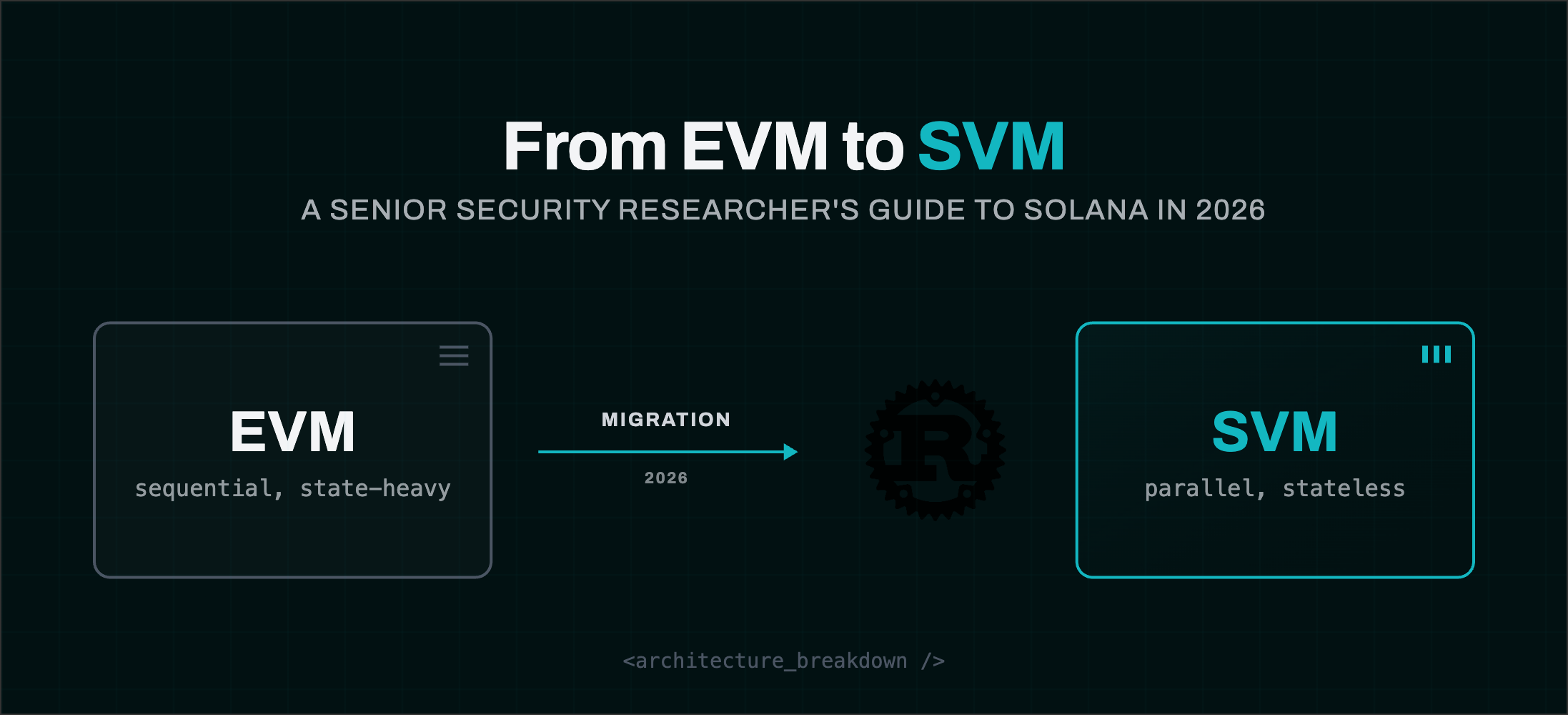
From EVM to SVM: A senior security researcher's guide to Solana in 2026
A technical guide for senior EVM security researchers transitioning to Solana's SVM. Covers Rust, Borsh, PDAs, Anchor, and the 2026 Solana security landscape.
Solana Security Checklist: 45 Anchor and Native Program Audit Checks
Run 45 Solana audit checks for Anchor and native programs, covering signer validation, CPI safety, PDAs, Token-2022, and pre-launch review.
Related Terms
SVM (Solana Virtual Machine)
The runtime environment that executes programs on Solana using a parallelized, stateless account model, compiled to Solana Bytecode Format (SBF).
Bump Seed Canonicalization
The practice of using the first valid bump seed found during PDA derivation to ensure a single canonical address per seed set, preventing duplicate account attacks.
Anchor Framework
The standard development framework for Solana programs that provides declarative security constraints, automatic account validation, and serialization through Rust macros.
Need expert guidance on Program Derived Address (PDA)?
Our team at Zealynx has deep expertise in blockchain security and DeFi protocols. Whether you need an audit or consultation, we're here to help.
Get a Quote