SVM (Solana Virtual Machine)
The runtime environment that executes programs on Solana using a parallelized, stateless account model, compiled to Solana Bytecode Format (SBF).
The Solana Virtual Machine (SVM) is the execution environment that runs smart contracts (called "programs") on the Solana blockchain. Unlike the EVM, which processes transactions sequentially using a stack-based architecture, the SVM leverages a register-based model compiled to Solana Bytecode Format (SBF), a specialized variant of eBPF (extended Berkeley Packet Filter).
How the SVM differs from the EVM
The fundamental architectural difference is parallelism. The EVM processes transactions one at a time because contracts can read and write shared global state. The SVM requires every transaction to declare its account dependencies upfront, enabling the Sealevel runtime to execute non-conflicting transactions in parallel.
| Feature | EVM | SVM |
|---|---|---|
| Execution model | Sequential, stack-based | Parallel, register-based |
| State access | Global state, any contract can read/write | Accounts must be declared upfront |
| Compilation target | EVM bytecode | SBF (eBPF variant) |
| Smart contract language | Solidity, Vyper | Rust, C |
| Memory model | Managed (stack + memory + storage) | Explicit ownership via Rust's borrow checker |
Account model
In the SVM, all state is stored in accounts. Programs themselves are stateless—they read from and write to accounts passed as instruction arguments. This design enables parallel execution but introduces unique attack surfaces like account injection, where a malicious actor passes unexpected accounts to a program.
Security implications for auditors
The SVM's stateless architecture shifts the auditor's focus from state-mutation patterns (like reentrancy in the EVM) to account validation and instruction data parsing. Key audit concerns include:
- Verifying account ownership and signer status
- Ensuring PDA derivation uses canonical bump seeds
- Validating Borsh deserialization boundaries to prevent type cosplay attacks
- Checking that Cross-Program Invocations (CPIs) correctly propagate signer privileges
The SVM is the foundation of Solana's high-throughput architecture and understanding its execution model is essential for any security researcher transitioning from EVM-based ecosystems.
Articles Using This Term
Learn more about SVM (Solana Virtual Machine) in these articles:
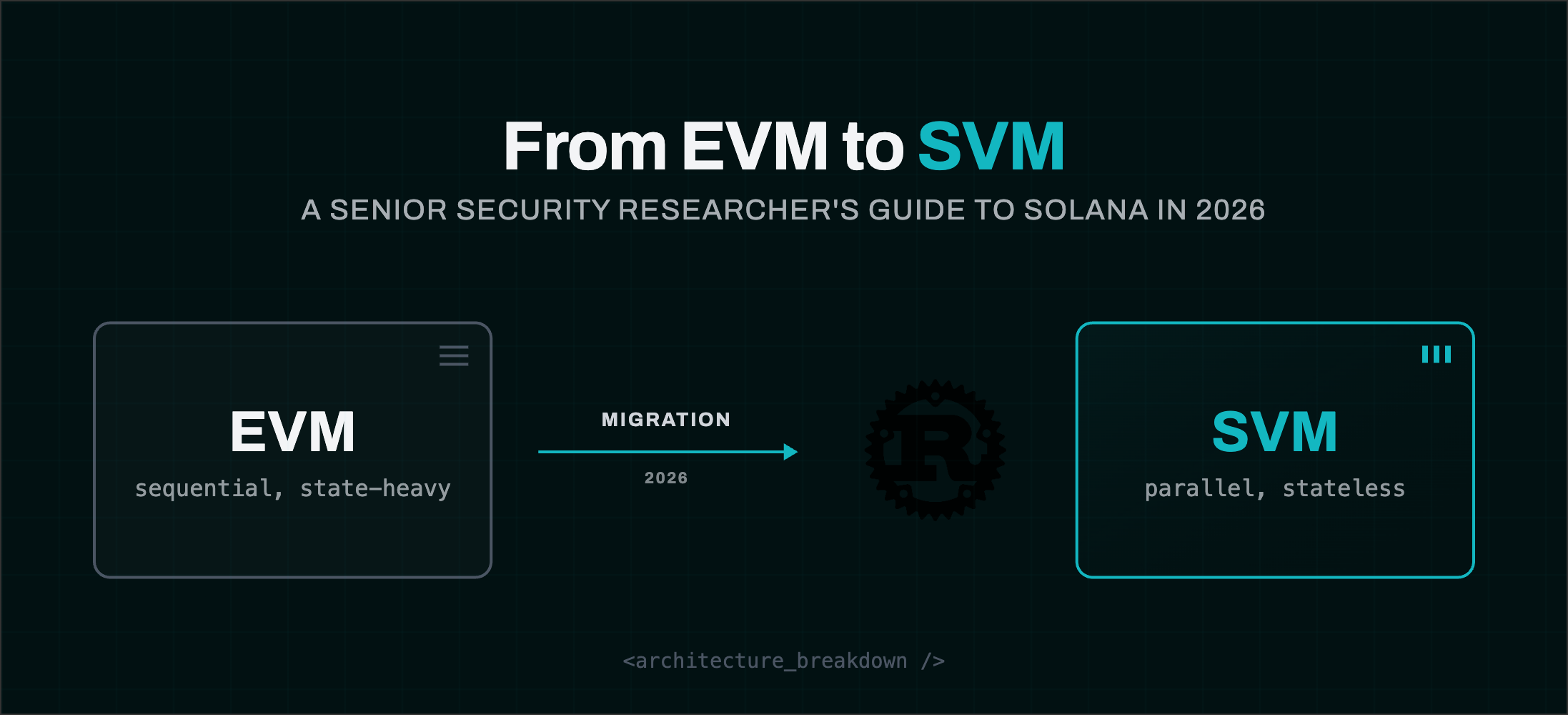
From EVM to SVM: A senior security researcher's guide to Solana in 2026
A technical guide for senior EVM security researchers transitioning to Solana's SVM. Covers Rust, Borsh, PDAs, Anchor, and the 2026 Solana security landscape.
Solana Audit Guide 2026: Firedancer, Token-2022, and Localized DoS
Solana audit guide for 2026 covering Firedancer finality risk, Token-2022 transfer hook reviews, localized DoS pressure, and what auditors check before launch.
Related Terms
EVM (Ethereum Virtual Machine)
The runtime environment for executing smart contract bytecode on Ethereum and compatible blockchains.
Sealevel
Solana's parallel transaction processing runtime that enables concurrent execution of non-overlapping transactions by requiring upfront account dependency declaration.
Program Derived Address (PDA)
A deterministic address derived from a combination of seeds and a program ID that falls off the Ed25519 curve, allowing programs to sign transactions without a private key.
Firedancer
High-performance Solana validator client that moves the network's performance limit to the hardware layer, enabling dynamic block sizing and multi-client consensus.
Need expert guidance on SVM (Solana Virtual Machine)?
Our team at Zealynx has deep expertise in blockchain security and DeFi protocols. Whether you need an audit or consultation, we're here to help.
Get a Quote