Restaking
Reusing already-staked ETH to secure additional services beyond Ethereum itself, earning extra yield in exchange for accepting additional slashing conditions.
Restaking lets ETH that is already staked on Ethereum — or a liquid staking token (LST) that wraps a native staking position — be reused to secure additional services on top of the base chain. On EigenLayer these services are called AVSs (Actively Validated Services). Stakers delegate their stake to operators, operators opt into a set of AVSs, and in return for the extra yield they accept the extra slashing conditions those AVSs impose.
The core tradeoff is capital efficiency versus concentrated risk: the same stake earns yield from several sources at once, but it also becomes exposed to the failure of every service it secures.
How restaking works
- Stakers deposit ETH or an LST and delegate it to an operator.
- Operators run the software for the AVSs they choose to serve and allocate a portion of their delegated stake to each.
- AVSs consume this pooled economic security and define the conditions under which stake can be slashed.
A liquid restaking token (LRT) wraps a restaked position into a transferable token, the same way an LST wraps a native staking position — adding yet another contract layer between the holder and the underlying ETH.
Security surfaces
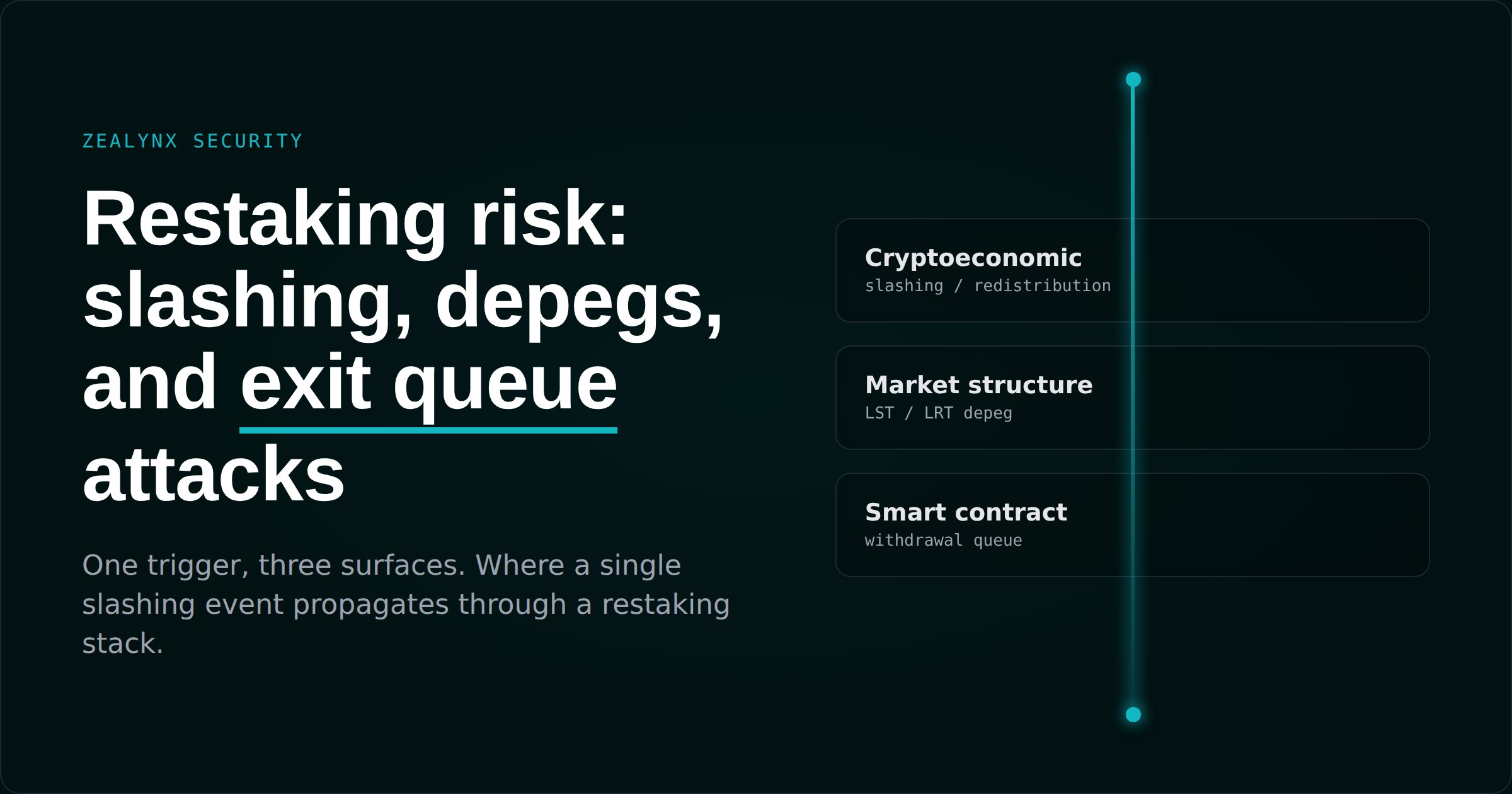
Restaking is not a single risk but three distinct failure surfaces sharing one product:
- Cryptoeconomic — slashing, and the redistribution variant (ELIP-006) that lets slashed funds be routed to a recipient address rather than burned, turning a compromised slashing key into a potential theft. Unique Stake and Operator Sets localize slashing so one bad AVS cannot trigger systemic loss.
- Market structure — an LST or LRT can depeg not because it is unbacked but because it cannot be redeemed fast enough; duration risk in the withdrawal queue widens the discount, and leverage loops (often powered by flash loans) turn that discount into a liquidation cascade.
- Smart-contract and mechanism — the withdrawal queue is a shared resource that can be griefed, and the accounting around native-stake verification, share conversions, and reentrancy is where real audit findings live.
The surfaces are distinct, but a single trigger — a slashing event, for example — can propagate across all three, so the blast radius is not.
Articles Using This Term
Learn more about Restaking in these articles:
Related Terms
Validator Set
The group of nodes responsible for validating transactions and reaching consensus in a blockchain network or cross-chain bridge.
Oracle
A service that provides external data (prices, events, random numbers) to smart contracts that cannot access off-chain information directly.
Flash Loan
A flash loan is an uncollateralized DeFi loan borrowed and repaid within one atomic transaction, commonly used for arbitrage, liquidations, and attacks.
Withdrawal Pattern
A security pattern where users pull funds from a contract rather than the contract pushing funds to users, reducing reentrancy risk.
TVL
Total Value Locked representing the aggregate dollar value of assets deposited in a DeFi protocol at any given time.
Need expert guidance on Restaking?
Our team at Zealynx has deep expertise in blockchain security and DeFi protocols. Whether you need an audit or consultation, we're here to help.
Get a Quote