Audit Timeline
The full sequence of security activities a smart contract protocol schedules across its lifecycle — architecture review, mid-development checkpoint, pre-launch audit, fix-review, public bounty, post-deploy audit, and recurring re-audits — rather than a single point-in-time engagement.
Audit Timeline describes the full sequence of security activities a Web3 protocol schedules across its development lifecycle — not a single audit at the end of development, but a series of touchpoints that begins at architecture and continues indefinitely after mainnet.
Why a timeline, not a milestone
A single audit attests to one commit hash under one set of assumptions. The moment code, dependencies, governance, or the underlying EVM change, that audit's coverage narrows — the audit decay problem. Mature protocols treat security as a continuous discipline distributed across time, with each activity placed at the lifecycle stage where it is dramatically more cost-effective than at any other stage. NIST puts post-production fixes at roughly 30x the cost of development-time fixes; in immutable smart contract environments the multiplier is sharper still, because production exposes bearer assets to attackers who are paid in cash within minutes of a successful exploit.
The five canonical touchpoints
A serious DeFi protocol typically schedules five external touchpoints:
- Architecture review — a senior researcher reads the whitepaper and contract layout, produces trust-boundary diagrams, an invariant catalog, and an attack-tree sketch. One to two engineer-weeks. Before substantial code is written.
- Mid-development checkpoint — a partial review when 60-70% of code exists and interfaces are stable, catching design drift early. One to three engineer-weeks.
- Pre-launch audit — the headline engagement on frozen code. Two to eight weeks depending on scope. Manual review by an external firm, often layered with a competitive contest.
- Fix-review or re-audit — three to seven days within one to four weeks of remediation. Skipping this is how Nomad's
confirmAt[0x00] = 1change slipped through in May 2022 and enabled a $190M drain in August 2022. - Post-deploy audit — a review of the actually-deployed bytecode and configuration. Often the cheapest audit and the one most teams skip.
Lead time and buffer rules
Top-tier private firms (OpenZeppelin, Trail of Bits, Spearbit, Cantina, Zellic, ChainSecurity, Halborn, Sigma Prime, Certora, Runtime Verification) quote booking queues of four to twelve weeks from inquiry to kickoff. Reach out three months before target audit start; hold the slot six to eight weeks before code freeze. Plan four to eight weeks between audit start and mainnet for a standard DeFi protocol, eight to sixteen weeks for bridge-grade or financially complex systems. The single most expensive scheduling mistake is ending the audit on launch day with no buffer for findings.
Continuous coverage post-launch
The timeline does not end at T-0. Recurring audits trigger on every code change touching value-bearing contracts. Continuous monitoring (Forta, OpenZeppelin Defender, Hypernative, Hexagate) runs from day one of mainnet. A bug bounty scales with TVL — Immunefi's framework recommends critical payouts up to 10% of TVL-at-risk so the bounty beats the black-market price. Red-team exercises run every six to twelve months. Governance review applies to any proposal that changes parameters, oracles, or treasury. This is the structure SAMM's Verification practice and the SSDF's "Produce Well-Secured Software" group both prescribe.
Common timeline failure modes
- Auditing too early — significant churn during the engagement, auditors flag code you've already deleted, 30-60% of the fee is wasted on stale assurance.
- Auditing too late — critical findings land days before launch, founders pressure the team to ship anyway, remediation is rushed.
- One-and-done — protocol audits at launch, ships new collateral and new chains for 18 months without further review, eventually exploited. Euler ($197M, March 2023) is the canonical case.
- Audit theater — cheapest possible engagement, narrow scope, no remediation visible. False confidence is worse than no audit.
Articles Using This Term
Learn more about Audit Timeline in these articles:
When to audit a smart contract: The 2026 security timeline
The 2026 security timeline for Web3 protocols: when to audit at design, dev, pre-launch, and post-launch — plus real lead times, audit costs, and launch buffer rules.
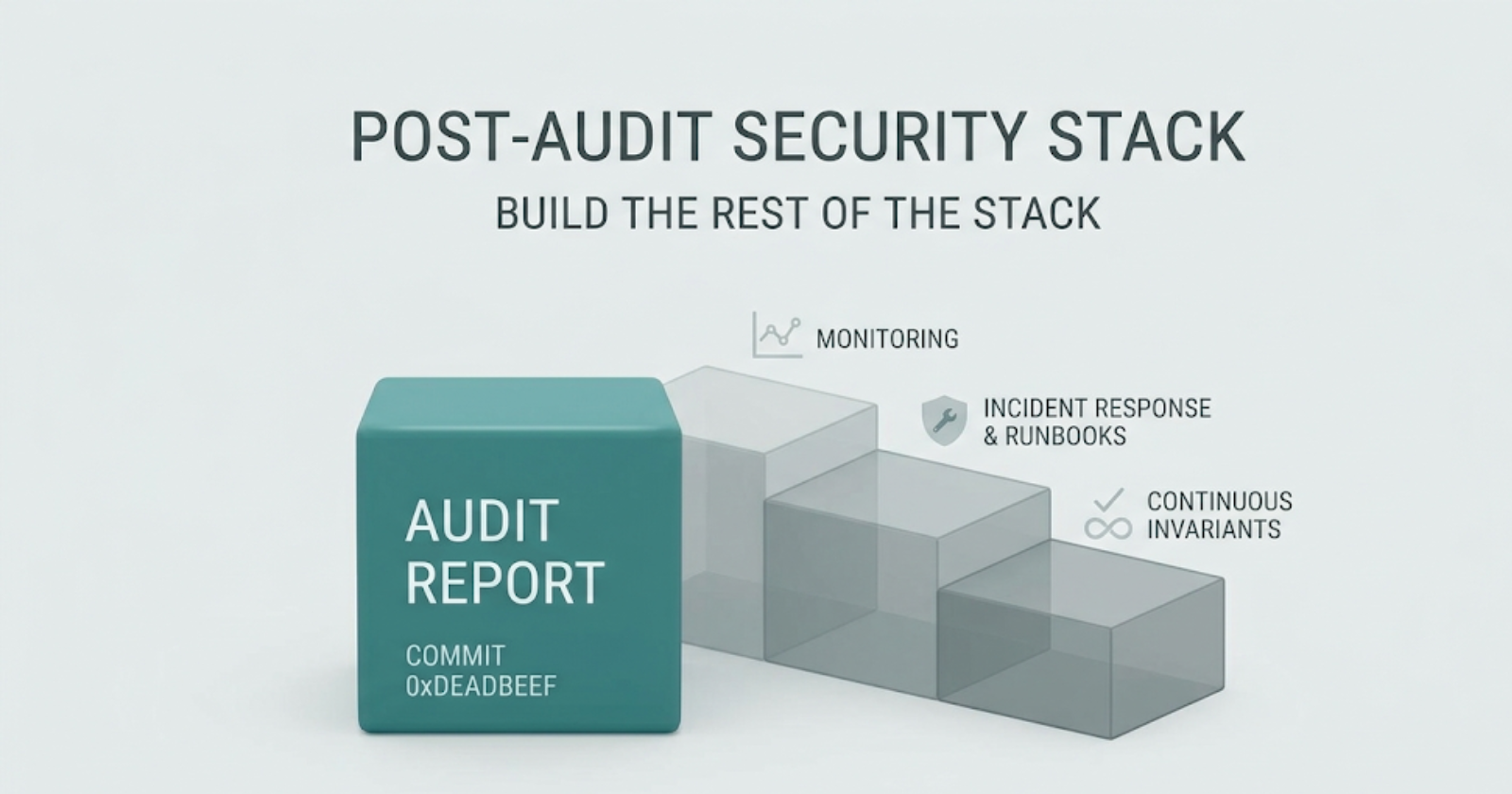
Post-audit security: why the audit is a commit hash, not a security posture
Audits attest to a commit hash, not protocol safety. Learn how monitoring, invariants, runbooks, and OpSec close the gap — with Euler, Nomad, Ronin, and Radiant case studies.
Beyond Static Checklists: A Defense‑in‑Depth Workflow for Smarter Smart Contract Audits
Transform static security checklists into a defense-in-depth engineering workflow using threat modeling, Slither, and Foundry invariant testing.
Related Terms
Audit Readiness
The state of a protocol's codebase and documentation being prepared for a formal security audit, including frozen code, test coverage, and documented invariants.
Audit Scope
The defined boundaries of a security audit, specifying which contracts, functions, and concerns will be reviewed.
Audit Decay
The gradual divergence between a point-in-time audit report and the live protocol, caused by code changes, dependency upgrades, governance actions, and EVM-level shifts after the audit closes.
SDLC
Software Development Life Cycle — the structured process of planning, creating, testing, and deploying software through defined phases.
Defense in Depth
Layered security strategy combining multiple independent protections rather than relying on single security measures.
Competitive Audit
Public security review where multiple auditors compete to find vulnerabilities with rewards based on severity and discovery priority.
Bug Bounty
Reward program incentivizing security researchers to find and report vulnerabilities before malicious exploitation.
Need expert guidance on Audit Timeline?
Our team at Zealynx has deep expertise in blockchain security and DeFi protocols. Whether you need an audit or consultation, we're here to help.
Get a Quote