JIT Liquidity Attack
A v3-specific MEV attack where attackers add liquidity just before large swaps to capture fees with minimal risk.
JIT (Just-In-Time) Liquidity Attacks represent a sophisticated MEV extraction strategy unique to Uniswap v3's concentrated liquidity architecture. These attacks exploit the ability to provide highly concentrated liquidity in narrow price ranges immediately before large swaps execute, capturing disproportionate trading fees before removing liquidity—all within a single transaction block with minimal capital risk exposure.
Attack Mechanism and Execution
JIT attacks unfold through a carefully orchestrated sequence executed atomically within one block. The attacker monitors the mempool for large pending swaps that will generate substantial trading fees. Upon identifying a profitable target, the attacker constructs a bundle containing three operations: adding massive liquidity in an extremely narrow range around the current price, allowing the victim's swap to execute against this liquidity, then immediately removing the liquidity.
The attacker's position is typically highly concentrated—often spanning just a few ticks around current market price. This concentration maximizes the proportion of the swap routing through the attacker's active liquidity rather than existing passive positions. The larger the victim's swap and the narrower the attacker's range, the greater the fee capture percentage.
By bundling all operations atomically, attackers eliminate the capital duration risk that legitimate long-term liquidity providers face. The liquidity exists for mere seconds (the duration of one block) rather than hours or days, yet captures fees equivalent to what passive providers would earn from many trades. This creates an extraction mechanism where sophisticated MEV searchers systematically siphon value from traditional LPs.
Economic Impact on Passive Liquidity Providers
JIT attacks fundamentally undermine v3's value proposition for passive liquidity providers. When significant fee-generating volume gets intercepted by just-in-time liquidity, passive LPs earn substantially less than they would without JIT activity. Research suggests that JIT attacks can capture 50-80% of fees from targeted large swaps, leaving passive providers with only residual earnings.
This dynamic disincentivizes long-term liquidity provision, particularly for assets where large swaps are frequent. Why provide continuous liquidity with full capital risk exposure when sophisticated actors can swoop in to capture the most profitable trades? The resulting reduction in passive liquidity can decrease pool depth, increase slippage for average trades, and create worse overall market quality—a tragedy of the commons scenario where individually rational MEV extraction degrades collective outcomes.
Comparison to Sandwich Attacks
While both JIT attacks and sandwich attacks exploit mempool visibility and transaction ordering, their mechanisms differ fundamentally. Sandwich attacks manipulate prices through front-running and back-running to extract value directly from victims through artificially induced slippage. JIT attacks don't manipulate prices—they merely insert liquidity to capture fees that would otherwise accrue to passive LPs.
Victim experience varies accordingly. Sandwich attack victims receive worse execution prices than they would absent the attack. JIT attack victims actually benefit from additional liquidity—they experience better execution than they would trading against only passive positions. The value extraction occurs not from victims but from other liquidity providers, making JIT attacks less obviously malicious despite their rent-seeking nature.
Technical Detection and Mitigation
Identifying JIT attacks requires analyzing liquidity provision patterns across blocks. On-chain analytics can detect positions that exist for single blocks coinciding with large swaps—clear fingerprints of JIT activity. Dune Analytics dashboards track JIT attack prevalence across pools, revealing that activity concentrates in high-volume pairs where large swaps generate substantial fees.
Protocol-level mitigation options remain limited without sacrificing v3's core flexibility. Introducing minimum liquidity duration requirements would prevent atomic JIT attacks but also restrict legitimate use cases requiring quick position adjustments. Some proposed solutions include fee structures that reward longer-duration liquidity provision or implementing commit-reveal schemes for liquidity additions, though these introduce their own complexities and trade-offs.
Market Dynamics and Searcher Competition
JIT attacks create fierce competition among MEV searchers, with profits accruing to those with superior mempool monitoring, execution infrastructure, and block builder relationships. This competition can actually benefit traders—competing JIT providers effectively create a bid/ask spread for liquidity provision services, with the most efficient operators winning trades. However, this efficiency gain comes at the expense of passive LPs who bear continuous risk for diminished returns.
The rise of private transaction pools like Flashbots Protect partially mitigates JIT attacks by hiding transactions from public mempool observation. Traders submitting swaps privately prevent JIT attackers from detecting opportunities, though this introduces centralization concerns and doesn't protect users unfamiliar with private submission infrastructure.
Future Implications and Protocol Evolution
JIT attacks highlight tensions between capital efficiency and fair value distribution in concentrated liquidity systems. Uniswap v4's hooks architecture enables pools to implement custom anti-JIT logic if desired, such as tracking liquidity provision duration or implementing fee discounts for long-term positions. However, whether such mechanisms gain adoption depends on whether pool creators prioritize passive LP protection over raw capital efficiency.
The existence of JIT attacks underscores a broader principle: sophisticated protocol designs create novel extraction vectors that emerge only after deployment when economic actors explore the strategy space. Understanding these dynamics proves essential for both protocol designers considering concentrated liquidity systems and liquidity providers evaluating their expected returns in v3 pools.
Articles Using This Term
Learn more about JIT Liquidity Attack in these articles:
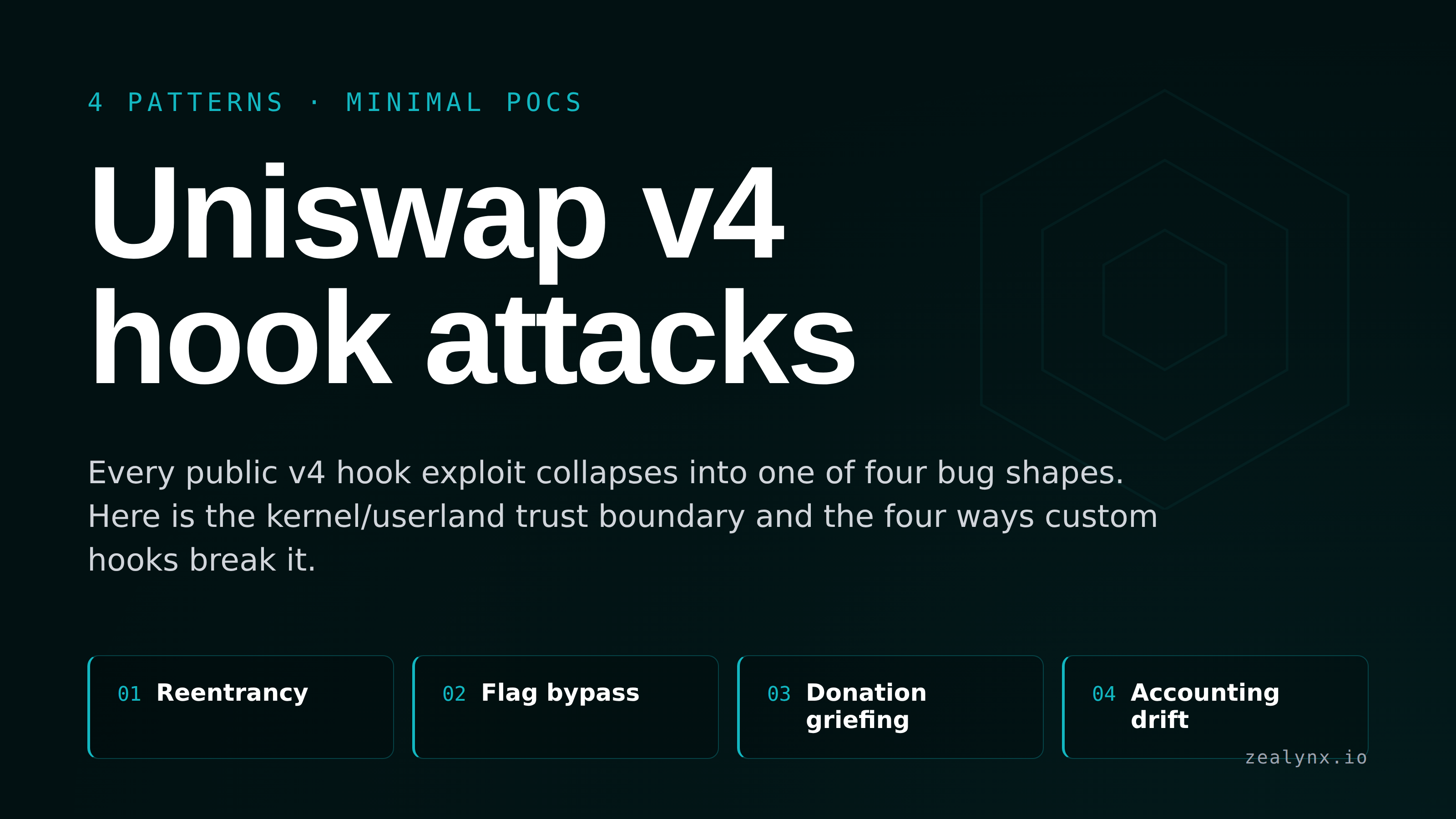
Uniswap v4 hook attacks: 4 exploit patterns with PoCs
The four Uniswap v4 hook attack patterns that cover every public exploit: reentrancy, flag bypass, donation griefing, accounting drift — with minimal PoCs.
Uniswap V3 Explained: Concentrated Liquidity, Tick Math & Security Risks
Uniswap V3 explained for developers. Learn concentrated liquidity, tick math, JIT liquidity, oracle manipulation, and the security checklist for safe integrations and forks.
Related Terms
MEV (Maximal Extractable Value)
Profit extracted by reordering, including, or excluding transactions within a block.
Concentrated Liquidity
A liquidity provision model where LPs can specify custom price ranges for their capital.
Active Liquidity
Liquidity within a position's price range that is currently being used for trades and earning fees.
Sandwich Attack
An MEV attack where an attacker front-runs and back-runs a victim's trade to extract profit from the induced price movement.
Need expert guidance on JIT Liquidity Attack?
Our team at Zealynx has deep expertise in blockchain security and DeFi protocols. Whether you need an audit or consultation, we're here to help.
Get a Quote