Hooks
External smart contracts in Uniswap v4 that execute custom logic at specific points in a pool's lifecycle.
Hooks represent the flagship feature of Uniswap v4, fundamentally transforming automated market maker extensibility through a plugin architecture. These external smart contracts enable developers to execute custom logic at specific lifecycle points in a pool's operations—before or after swaps, liquidity additions, or liquidity removals. This architectural innovation allows protocols to implement sophisticated functionality without modifying core protocol code, creating an ecosystem of composable AMM enhancements.
Hook Lifecycle Integration Points
The hook system provides comprehensive lifecycle coverage through paired before/after execution points. Initialization hooks (beforeInitialize and afterInitialize) execute when pools are first created, enabling custom setup logic or validation. Swap hooks (beforeSwap and afterSwap) trigger around token exchanges, allowing fee adjustments, MEV protection, or custom pricing logic.
Liquidity management hooks include beforeAddLiquidity and afterAddLiquidity for deposit operations, plus beforeRemoveLiquidity and afterRemoveLiquidity for withdrawals. These enable sophisticated position management strategies or custom accounting. Donation hooks (beforeDonate and afterDonate) handle direct liquidity contributions, supporting novel incentive mechanisms. This comprehensive coverage ensures developers can customize nearly every aspect of pool behavior.
Transformative Use Cases
Hooks enable previously impossible functionality within AMM protocols. Dynamic fee structures can automatically adjust trading fees based on realized volatility, ensuring compensation aligns with current risk levels. On-chain limit orders become feasible through hooks that implement more sophisticated order types than concentrated liquidity range orders alone permit.
Custom AMM curves extend beyond standard concentrated liquidity models, allowing protocols to implement novel pricing functions tailored to specific asset classes. MEV protection mechanisms can be built directly into pools, shielding users from front-running and sandwich attacks. Time-Weighted Average Market Maker (TWAMM) functionality enables efficient execution of large orders across multiple blocks, reducing price impact and improving execution quality.
Critical Security Implications
While hooks provide powerful extensibility, they introduce substantial security complexity that developers must carefully manage. Reentrancy vulnerabilities pose the primary threat, as hooks involve external calls that malicious contracts can exploit to manipulate protocol state. Access control failures can allow unauthorized actors to trigger hook logic inappropriately, potentially draining funds or corrupting state.
Gas-based denial of service attacks become possible when hooks contain unbounded operations that make pool interactions prohibitively expensive. Accounting manipulation through improper delta calculations in flash accounting systems can lead to fund loss or protocol insolvency. Developers must implement rigorous access controls, comprehensive reentrancy guards, extensive testing with malicious contracts, and thorough audits before deploying hooks to production. The Uniswap v4 security considerations provide essential guidance for hook developers navigating these challenges.
Articles Using This Term
Learn more about Hooks in these articles:
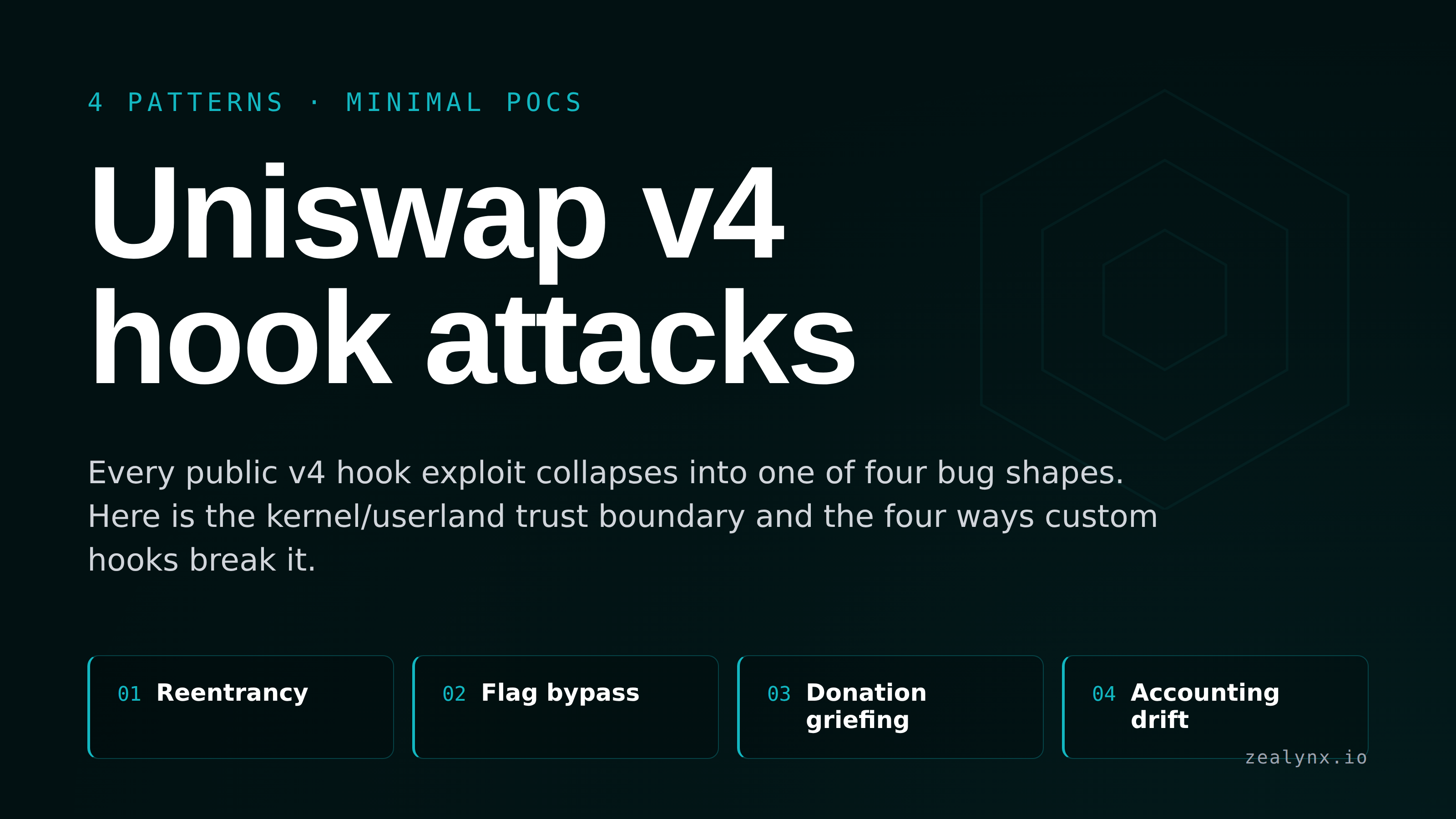
Uniswap v4 hook attacks: 4 exploit patterns with PoCs
The four Uniswap v4 hook attack patterns that cover every public exploit: reentrancy, flag bypass, donation griefing, accounting drift — with minimal PoCs.
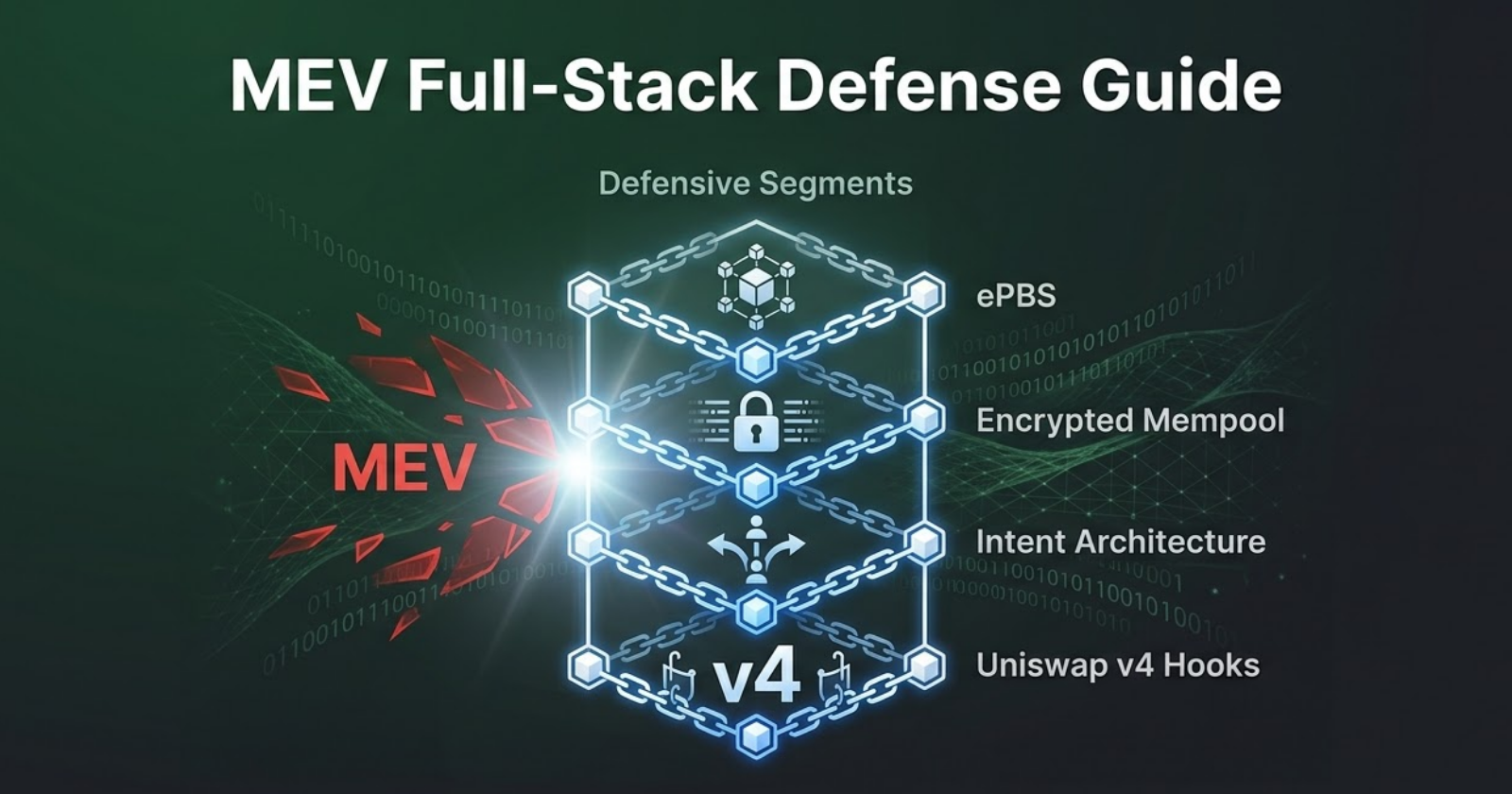
How to protect your DeFi protocol from MEV: A full-stack defense guide
Learn how to defend your DeFi protocol from sandwich attacks and MEV extraction with PBS, encrypted mempools, intent architectures, and Uniswap v4 hooks.
Uniswap v4 Security Guide: Hooks, Risks, and Audit Path
Uniswap v4 security guide for hook risk, singleton architecture, and flash accounting. See what builders should audit before launch.
Related Terms
Automated Market Maker (AMM)
A decentralized exchange protocol that uses mathematical formulas to price assets instead of order books.
Singleton Architecture
A design pattern where all pools are managed within a single unified contract, reducing gas costs.
Reentrancy Attack
A vulnerability where external calls allow malicious contracts to recursively call back before state updates complete.
Need expert guidance on Hooks?
Our team at Zealynx has deep expertise in blockchain security and DeFi protocols. Whether you need an audit or consultation, we're here to help.
Get a Quote