Governance Attack
An exploit that weaponizes a protocol's legitimate voting mechanics to pass malicious proposals or drain treasury funds.
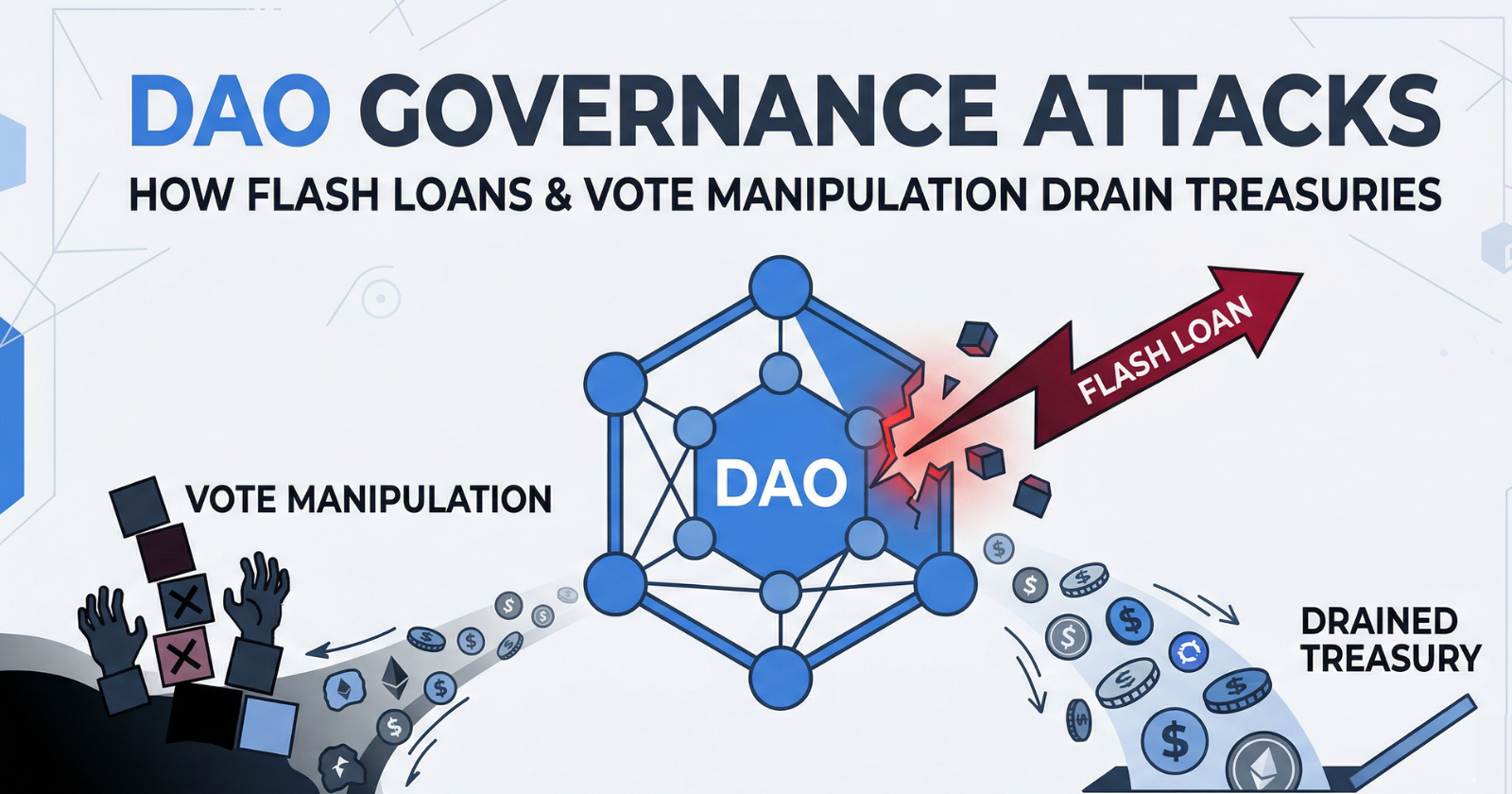
A governance attack is a class of exploit where an adversary manipulates a protocol's on-chain voting system to pass malicious proposals — treasury drains, parameter changes, or contract upgrades — using the protocol's own legitimate governance mechanics rather than exploiting software bugs.
Unlike traditional smart contract vulnerabilities (reentrancy, overflow, access control bypass), governance attacks operate within the deterministic rules of the protocol. The attacker follows the correct proposal and voting procedures; the exploit lies in acquiring disproportionate voting power through economic or technical manipulation.
Primary attack vectors
Flash loan governance attacks use uncollateralized flash loans to borrow massive quantities of governance tokens, vote on or execute a malicious proposal, and repay the loan — all within a single atomic transaction. The attacker risks zero capital. The $182 million Beanstalk exploit (2022) is the canonical example.
Quorum exhaustion exploits low voter participation. When a protocol's quorum threshold is set relative to circulating supply rather than total supply, or when historical participation is low, an attacker can accumulate enough tokens to single-handedly meet quorum and pass proposals that the majority of holders never see.
Bytecode injection combines social engineering with EVM opcode manipulation. The Tornado Cash exploit (2023) used selfdestruct and CREATE2 to swap a benign contract for a hostile one at the same address after governance approval.
Vote buying and bribery operate through platforms like Votium or Hidden Hand, where attackers pay token holders to vote in their favor. While not always illegal, this financializes governance into pure economic transactionism.
Defenses
The primary defenses are temporal separation (timelocks), retrospective vote weight calculation (N-1 block checkpointing via ERC20Votes), quorum thresholds calibrated against total supply, and dual governance structures that give at-risk stakeholders veto power. See also DAO for governance architecture patterns.
Articles Using This Term
Learn more about Governance Attack in these articles:
Related Terms
DAO (Decentralized Autonomous Organization)
A blockchain-based organization governed by smart contracts and token-weighted voting rather than centralized management.
Flash Loan
A flash loan is an uncollateralized DeFi loan borrowed and repaid within one atomic transaction, commonly used for arbitrage, liquidations, and attacks.
Quorum
The minimum percentage of total voting power that must participate in a governance vote for the result to be considered valid.
Timelock
Smart contract mechanism enforcing mandatory delay between initiating and executing critical protocol changes for transparency.
Sybil Attack
An attack where a single entity creates many pseudonymous identities (wallets, accounts, nodes) to gain disproportionate influence in a system that assumes one-entity-one-identity. Common in airdrops, DAO governance, quadratic voting, and public-goods funding.
Need expert guidance on Governance Attack?
Our team at Zealynx has deep expertise in blockchain security and DeFi protocols. Whether you need an audit or consultation, we're here to help.
Get a Quote