DAO (Decentralized Autonomous Organization)
A blockchain-based organization governed by smart contracts and token-weighted voting rather than centralized management.
A Decentralized Autonomous Organization (DAO) is a blockchain-native entity that replaces traditional corporate hierarchies with smart contract-based governance. Decision-making is executed through on-chain voting systems, typically following a "one token, one vote" model where governance token holders propose, deliberate, and ratify protocol changes without centralized intermediaries.
DAOs emerged from the Ethereum ecosystem, with "The DAO" (2016) being the first large-scale experiment — raising $150 million before a reentrancy attack drained $60 million and triggered the Ethereum hard fork. Despite this early failure, the model evolved into the standard governance framework for DeFi protocols, NFT communities, and public goods funding.
How DAOs operate
The typical DAO lifecycle follows a proposal-vote-execute pattern enforced by smart contracts:
- A token holder submits a proposal (parameter change, treasury allocation, contract upgrade)
- A voting period opens, during which token holders cast votes weighted by their holdings
- If the proposal reaches the required quorum and approval threshold, it enters a timelock queue
- After the timelock delay expires, the proposal is executed automatically on-chain
Modern implementations use OpenZeppelin's Governor contract suite (GovernorVotes, GovernorTimelockControl, GovernorSettings) to standardize this flow.
Governance models
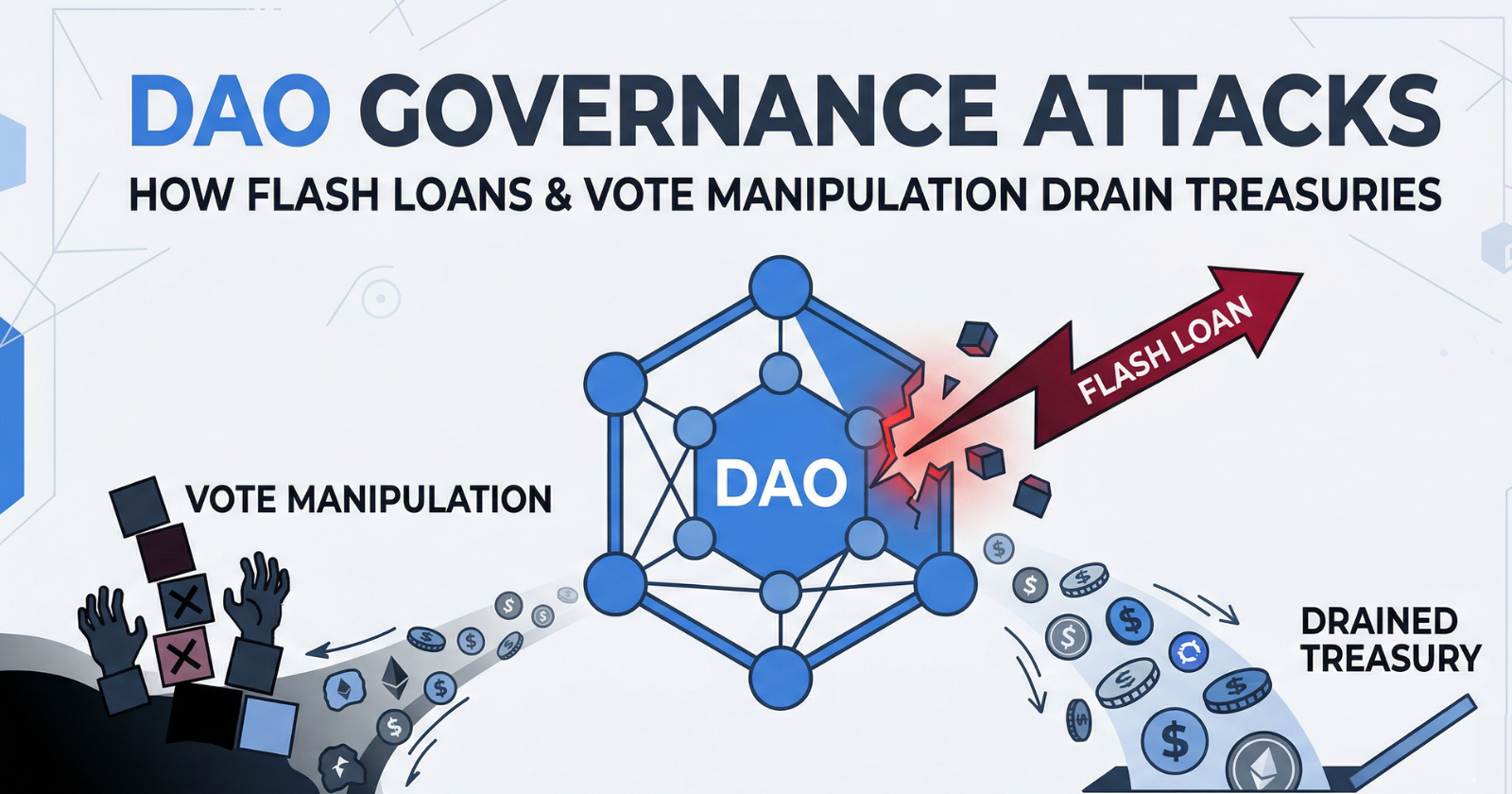
Token-weighted voting grants influence proportional to token holdings. Simple and transparent, but vulnerable to plutocratic capture and flash loan attacks where temporary token holders can overpower long-term stakeholders.
Vote-escrowed (ve) models require locking tokens for extended periods to earn voting power, pioneered by Curve Finance. This filters out short-term speculators but creates illiquidity and spawns secondary vote-buying markets.
Quadratic voting scales cost geometrically to reduce whale dominance, but permissionless networks leave it vulnerable to Sybil attacks.
Optimistic dual governance separates proposal creation from veto protection, allowing stakeholders whose capital is at risk to block hostile proposals through escrow-based signalling.
Security considerations
DAOs are uniquely vulnerable because governance attacks exploit legitimate protocol mechanics rather than software bugs. Attackers use the protocol's own voting rules to pass malicious proposals, making these exploits fundamentally different from traditional smart contract vulnerabilities. Key defense mechanisms include timelocks, N-1 block checkpointing for vote weight, quorum thresholds, and multi-sig execution requirements.
Notable governance exploits include the $182 million Beanstalk flash loan takeover (2022), the Tornado Cash CREATE2 bytecode injection (2023), and the $24 million Compound tunneling attack (2024).
Articles Using This Term
Learn more about DAO (Decentralized Autonomous Organization) in these articles:
Related Terms
Governance Attack
An exploit that weaponizes a protocol's legitimate voting mechanics to pass malicious proposals or drain treasury funds.
Quorum
The minimum percentage of total voting power that must participate in a governance vote for the result to be considered valid.
Timelock
Smart contract mechanism enforcing mandatory delay between initiating and executing critical protocol changes for transparency.
Flash Loan
A flash loan is an uncollateralized DeFi loan borrowed and repaid within one atomic transaction, commonly used for arbitrage, liquidations, and attacks.
Quadratic Voting
A voting mechanism where the cost of additional votes scales geometrically, reducing plutocratic dominance but vulnerable to Sybil attacks.
Need expert guidance on DAO (Decentralized Autonomous Organization)?
Our team at Zealynx has deep expertise in blockchain security and DeFi protocols. Whether you need an audit or consultation, we're here to help.
Get a Quote