Quadratic Voting
A voting mechanism where the cost of additional votes scales geometrically, reducing plutocratic dominance but vulnerable to Sybil attacks.
Quadratic Voting (QV) is a collective decision-making mechanism where the cost of casting votes follows a quadratic function: $Cost = Votes^2$. One vote costs 1 credit, two votes cost 4, three cost 9, and ten votes cost 100. This geometric scaling reduces the influence of wealthy participants (whales) while preserving the ability to express preference intensity — a participant who cares deeply about an issue can still cast multiple votes, but at rapidly increasing cost.
The concept was formalized by economist Glen Weyl and applied to blockchain governance by projects like Gitcoin Grants, where quadratic funding allocates matching funds based on the number of unique contributors rather than total contribution size.
How quadratic voting works
In traditional token-weighted voting (one token, one vote), a whale with 1 million tokens has 1 million times the influence of a holder with 1 token. Quadratic voting restructures this relationship:
| Votes desired | Linear cost | Quadratic cost |
|---|---|---|
| 1 | 1 | 1 |
| 10 | 10 | 100 |
| 100 | 100 | 10,000 |
| 1,000 | 1,000 | 1,000,000 |
A whale must spend 1,000,000 tokens to cast 1,000 votes, while 1,000 individual holders casting 1 vote each achieve the same result for 1,000 tokens total. This democratizes governance by making it exponentially expensive for any single entity to dominate.
The Sybil vulnerability
QV's primary weakness on permissionless networks is the Sybil attack. An attacker splits capital across many pseudonymous addresses, bypassing the quadratic penalty entirely. With 10,000 tokens across 100 wallets (100 tokens each), the attacker casts 10 votes per address at quadratic cost of 100 each — totaling 1,000 votes for 10,000 tokens. From a single address, 1,000 votes would cost 1,000,000 tokens. The Sybil attack reduces cost by 99%.
This is why QV requires Proof of Personhood (PoP) infrastructure to verify unique human identity. Without identity verification, quadratic voting on permissionless blockchains degrades to standard linear voting for any attacker willing to create multiple addresses.
Applications in governance
Gitcoin Grants uses quadratic funding — a related mechanism — to allocate matching pools. Projects with many small contributors receive proportionally more matching funds than projects with few large donors, encouraging broad community support. DAOs experimenting with QV include Optimism's Citizens' House and various community treasury allocation systems.
Articles Using This Term
Learn more about Quadratic Voting in these articles:
Related Terms
DAO (Decentralized Autonomous Organization)
A blockchain-based organization governed by smart contracts and token-weighted voting rather than centralized management.
Sybil Attack
An attack where a single entity creates many pseudonymous identities (wallets, accounts, nodes) to gain disproportionate influence in a system that assumes one-entity-one-identity. Common in airdrops, DAO governance, quadratic voting, and public-goods funding.
Governance Attack
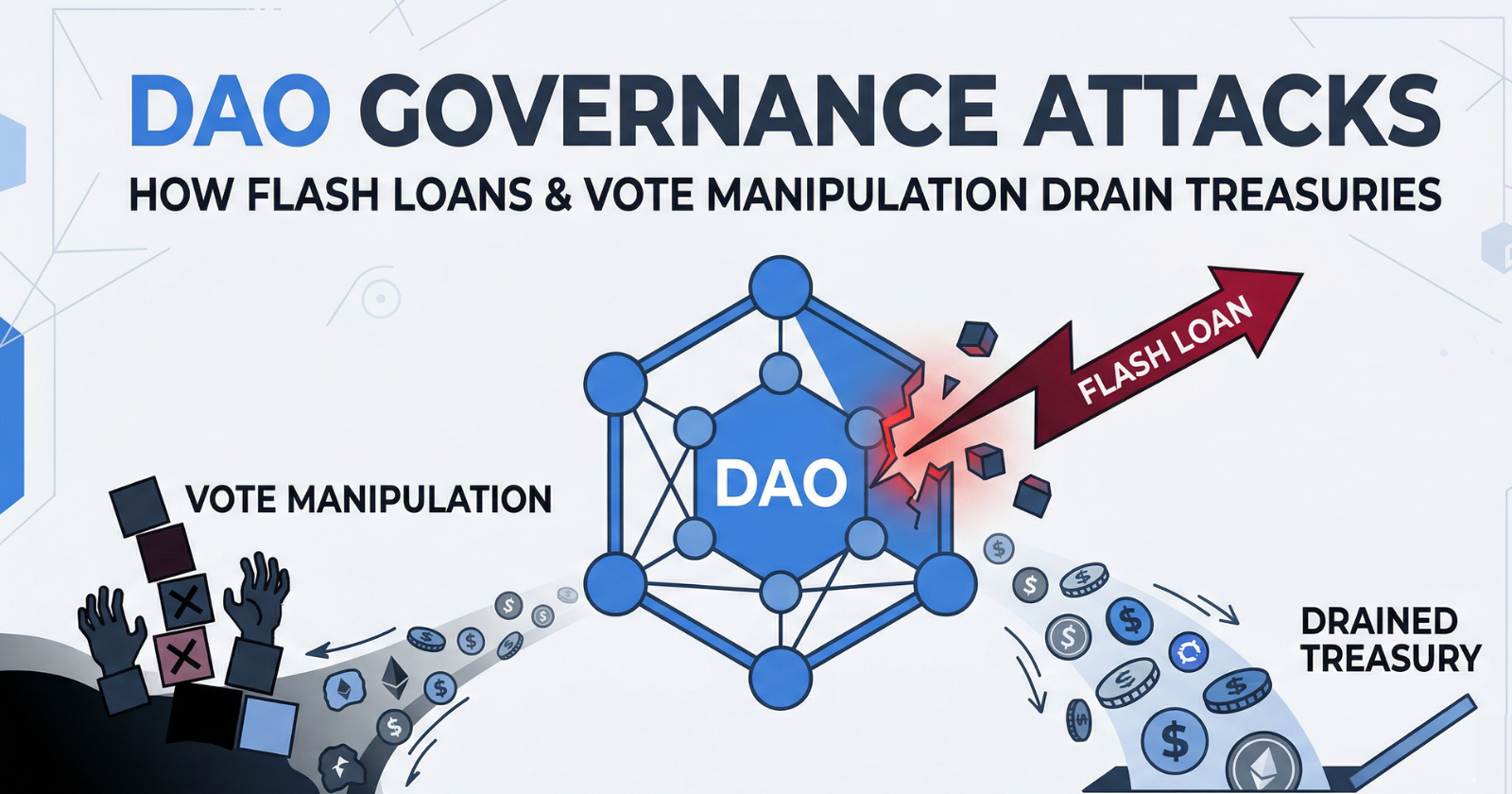
An exploit that weaponizes a protocol's legitimate voting mechanics to pass malicious proposals or drain treasury funds.
Quorum
The minimum percentage of total voting power that must participate in a governance vote for the result to be considered valid.
Need expert guidance on Quadratic Voting?
Our team at Zealynx has deep expertise in blockchain security and DeFi protocols. Whether you need an audit or consultation, we're here to help.
Get a Quote